Fuel poverty is an issue in the UK. In 2024, around 11% of households in England, or 2.73 million homes, were classed as fuel poor, with an average fuel poverty gap of £407. At the same time, how we use energy at home is shifting. As insulation and heating systems improve, water heating now accounts for around 17% of domestic energy use and more than a fifth of domestic gas consumption.
On top of this, the policy and funding landscape is moving. ECO4 is being wound down, and the new Warm Homes Plan and related funds are starting to come through. For housing associations, this poses a practical question: when funding, tariffs and schemes keep changing, what kind of heating and hot water systems really help reduce fuel poverty?
This article looks at what ECO changes and the Warm Homes Plan mean, and how heating design choices like tariff shifting, low heat loss storage and compact heat batteries can support more affordable, reliable hot water for vulnerable residents.
ECO cuts and the Warm Homes Plan: the new funding context
The Energy Company Obligation (ECO) has aimed at improving the energy efficiency of low-income homes for more than a decade. Around 15 million homes have had measures installed under ECO since 2013.
ECO4, the current phase, is now being brought to an early close as part of wider changes to energy levies and domestic bills, as announced in the Autumn 2025 budget.
Ending ECO4 from 2026 is expected to remove £1.3 billion per year of levy funded support. Industry estimates suggest that up to 222,000 planned retrofit projects could be lost if replacement programmes do not make up the difference.
The Warm Homes Plan is aimed to provide that longer term framework. Government has committed £13.2 billion for the Plan between 2025 and 2030, with an extra £1.5 billion announced in the 2025 Autumn Budget, plus specific budget lines in the 2025 Budget for expanding the Plan and the Warm Home Discount.
For social housing, the funding picture is more targeted. The Warm Homes: Social Housing Fund, which follows on from the Social Housing Decarbonisation Fund Wave 3, has an initial allocation of £1.29 billion for 2025-2028. There is also £500 million through the Warm Homes: Local Grant. Together these form a £1.79 billion package.
Demand is strong. The social housing fund has already been oversubscribed by more than £1 billion in bids. There are 144 projects that have been awarded funding and several schemes waiting for future waves.
Social housing landlords can also lean on National Wealth Fund/UK Infrastructure Bank guarantees of up to £1 billion of loan, which underwrite retrofit finance for social housing providers, to help them borrow cheaply for energy efficiency and low carbon heat.
So, for social housing, the picture is: Warm Homes: Social Housing Fund, Warm Homes: Local Grant plus some borrowing through the National Wealth Fund.
Against this backdrop, it is critical that each funded scheme delivers reductions in residents’ energy bills and isn’t just about meeting compliance targets. It’s also about cutting fuel poverty and meeting tenant comfort.
How can efficient domestic hot water delivery make a difference in cutting fuel poverty?
Nationally, water heating now accounts for around 17-18% of domestic energy use and about 22 % of domestic gas demand. Unlike space heating, which is more weather dependent, hot water demand remains constant throughout the year. It is linked to daily comfort, hygiene and dignity.
For fuel poor residents, inefficient hot water systems can have serious impacts:
- High standing losses from older cylinders that leak heat into already cramped airing cupboards
- Long reheat times mean vulnerable residents may leave immersion heaters on all the time, pushing up peak electricity bills
- Systems that cannot easily use cheaper off peak or time of use tariffs, so residents pay high unit costs whenever they need hot water
From the landlord’s point of view, housing associations are under growing pressure to lift EPC ratings towards EPC C or better across their stock while managing tight budgets, meeting fuel poverty and carbon targets in their strategies; maintaining annual safety checks, especially around Legionella risk in stored hot water; and keeping disruption as low as possible in occupied homes.
These pressures mean hot water can no longer be treated as a ‘plumbing afterthought’. It is now a key part of fuel poverty strategies.
Three design changes related to hot water storage in social housing that can make a difference
- Cut standing losses, not just emissions
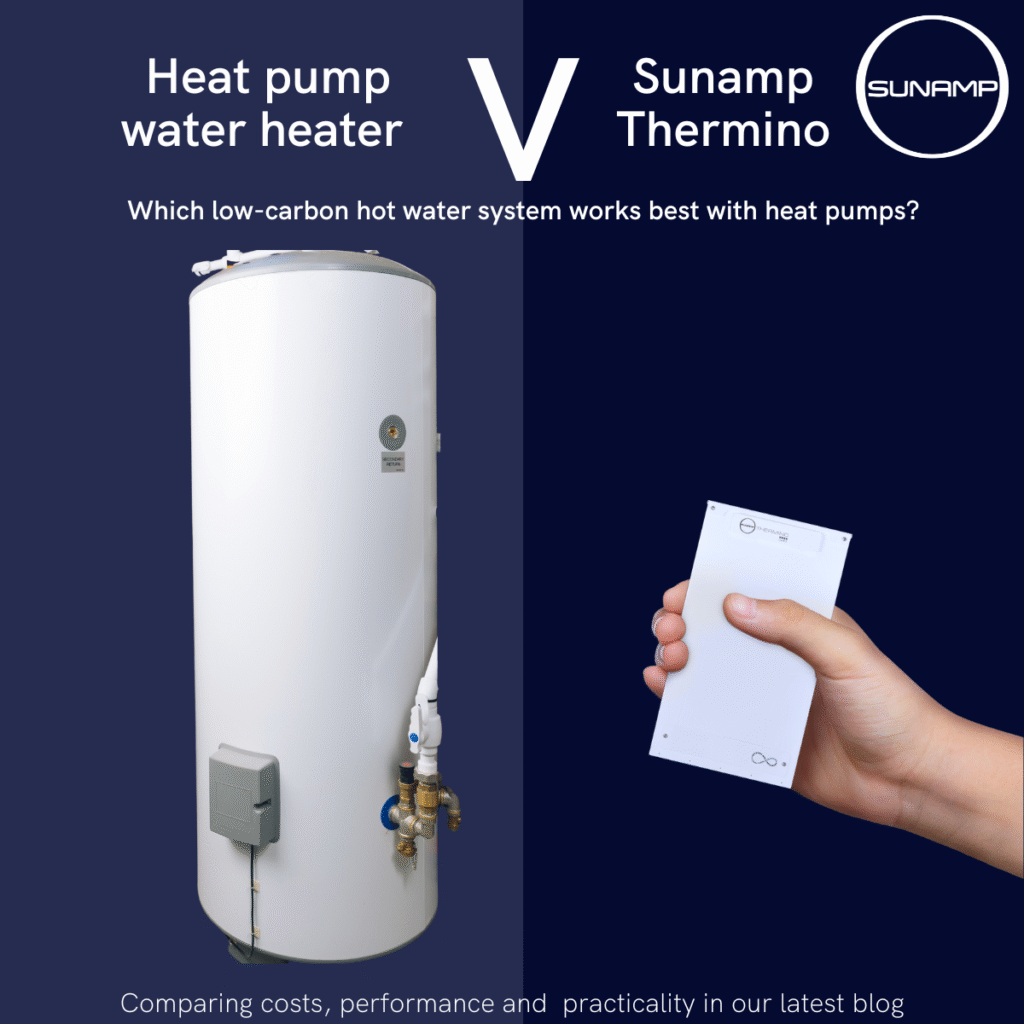
Traditional hot water cylinders, especially older unvented units, can lose between roughly 1.3-3.3 kWh of heat every day, depending on age and insulation quality. Over a year, that is roughly 500 to 1,200 kWh of energy that never reaches a tap or shower. This is where Thermino heat batteries make a big difference. Our PCM heat batteries have a minimal heat loss rate, less than a quarter of a conventional hot water cylinder, thanks to the vacuum insulation and compact size.
Designing out fuel poverty means choosing low loss thermal storage solutions which can make the most of renewables. High performance thermal storage, including Sunamp’s compact heat batteries, can work alongside insulation and heating upgrades to reduce these background losses.
- Enable tariff shifting through thermal storage to cut bills
As more residents will move to electric heating and as electricity tariffs become more dynamic, the ability to move hot water production into cheaper tariff periods becomes important. Ofgem and others have highlighted the role of demand flexibility and time of use tariffs in cutting system costs as the grid decarbonises. For fuel poor households on electric heating, this only works if the thermal storage equipment can retain heat for many hours with low losses.
Hot water systems that can charge overnight on cheaper tariffs and then supply mains pressure hot water during the day offer a practical way to reduce bills, especially when paired with heat pumps or smart tariffs.
- Protect reliability and health for vulnerable residents
For vulnerable and older residents, unreliable hot water is more than an inconvenience. System design should therefore aim for consistent, mains pressure hot water at the taps, even where space is limited. Resilience to tariff changes or short outages, and strong Legionella control that does not rely only on running systems at high temperatures that increase bills is also important.
Our separate article on designing Legionella safe hot water systems looks at this in more detail.
Where communal or heat network solutions are used, hot water design also links to system temperatures and return losses. We explored that in our blog on decarbonising heat networks in social housing.
How compact heat batteries can support Warm Homes objectives
Compact heat batteries such as our Thermino range of PCM heat batteries address many of these fuel poverty challenges.
Ultra-low loss thermal storage that supports tariff shifting
Thermino heat batteries use Plentigrade phase change material to store heat in a modular, compact and vacuum insulated unit. Because the energy is stored as latent heat, the heat batteries take up to four times less space than an equivalent hot water cylinder.
For fuel poverty, the key point is that Thermino heat batteries have very low standing losses. Compared with older cylinders that may lose 1.3 to 3.3 kWh per day, a Thermino can cut heat loss to less than a quarter of that amount. This means more of the energy residents pay for reaches their taps.
In practice, this makes Thermino suitable for charging from off peak or time of use tariffs, with enough stored energy to meet daytime demand. The heat batteries also work with heat pumps & solar PV, eliminating the need for residents to keep immersion heaters running during peak tariff hours.
Reliable hot water without compromising safety
Thermino delivers mains pressure domestic hot water on demand, while only storing <15L of water. This reduces Legionella risk and removes the need for regular anti-legionella cycles, which increase bills.
For housing associations, this means easier compliance with hot water safety guidance (Building G3) and fewer call out jobs/maintenance hassles related to loss of domestic hot water.
Space saving and ease of retrofit
In our earlier article on retrofitting Britain’s hard to heat homes, we showed how space constraints can make retrofit projects difficult in flats, tower blocks and compact homes.
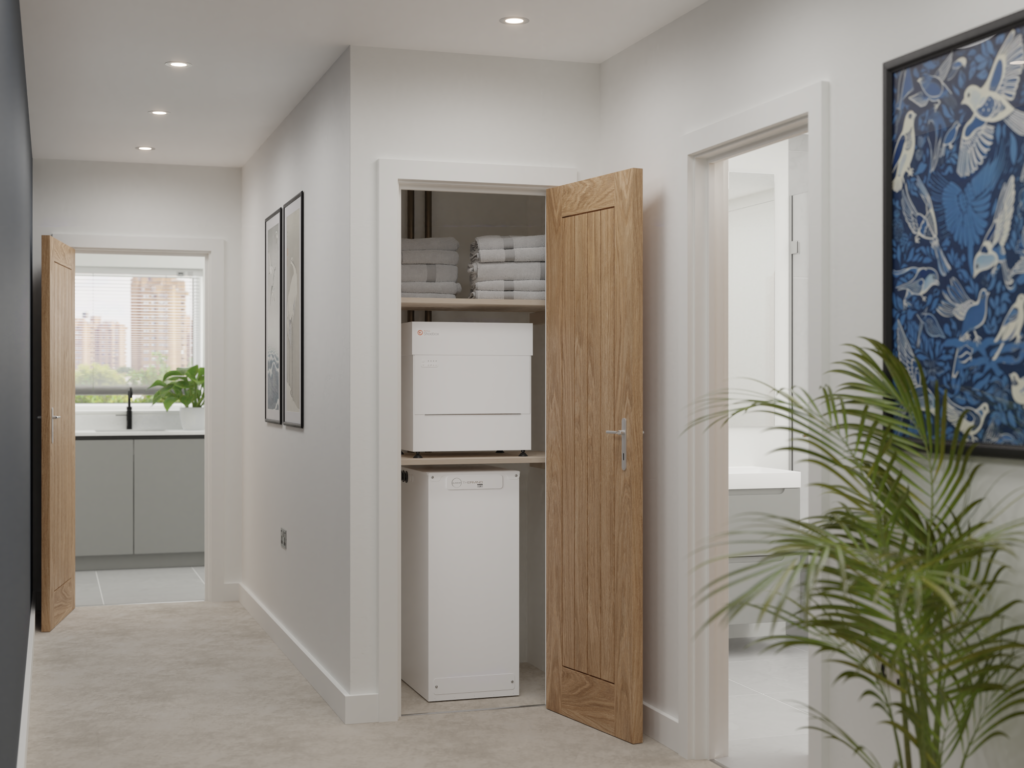
Thermino’s compact footprint free up valuable space in small properties. This also helps a) residents in gaining storage space, b) retrofit teams who can run pipework with with minimal disruption and c) architects who can improve energy performance without giving up liveable space.
Scaling across a portfolio
For using Warm Homes programmes to retrofit in social housing, being able to repeat a design at scale is important. Housing associations can use Thermino BIM drawings to integrate into their design spaces. They can also manually entered into SAP 10.2 software to model dwelling energy performance of your housing stock.
The energy performance data can then be reported against Warm Homes: Social Housing Fund outcomes and internal fuel poverty targets. For instance, Thurrock council used social housing decarbonisation fund to retrofit Kensa heat pumps paired with Thermino heat batteries, which are estimated to cut 67% in energy bills and 70% CO2 emissions compared to old storage heaters and cylinders.
ECO cuts and the move to the Warm Homes Plan create uncertainty, particularly for residents who are already close to fuel poverty.
At the same time, targeted social housing funds and a clearer long term retrofit framework give housing associations a chance to do more than like for like replacements.
By treating hot water systems as a central part of fuel poverty strategy, and by designing for low standing losses, tariff shifting and reliable service for vulnerable residents, landlords can use government funding to deliver lasting reductions in energy bills.
Compact thermal storage solutions like Sunamp’s Thermino heat batteries offer one way to do this. They replace traditional cylinders with ultra low loss, space saving storage that fits with the Warm Homes policy framework and supports wider decarbonisation of heat.
If you are reviewing your hot water strategy after ECO changes or planning a Warm Homes: Social Housing Fund bid, our team can help you understand where compact heat batteries fit into your design plans and how they can support the residents most at risk of fuel poverty.
Click here to get in touch.