For HVAC, heat pump or other equipment manufacturers considering building thermal storage products, choosing a phase change material (PCM) often starts with a simple question: what phase change temperature do we need?
It is the right place to start but it does not cover the whole decision.
A PCM can look suitable on a data sheet and still underperform in a thermal storage product. History has shown why. The Dover Sun House, one of the most prominent early attempts to use salt hydrate PCM for thermal storage, suffered from issues including segregation and leakage after repeated melting and cooling.
That does not mean PCMs are unreliable.
“PCM selection is not a catalogue exercise. It is a system design decision, and for manufacturers looking to build their thermal storage product, a product strategy decision too. The material has to work technically, but it also has to fit into the overall system, manufacturing route, commercial model and end-user application.”
– Dr. Kate Fisher, head of materials at Sunamp.
At Sunamp, this is how we approach our Plentigrade PCM technology. It is not just a range of phase change materials. It is a thermal storage platform built around material formulation, nucleation control, heat exchanger compatibility, product design, manufacturing knowledge, certification and real-world deployment.
What should manufacturers consider when choosing a PCM
The best phase change material for thermal energy storage is not simply the material with the highest latent heat or the closest melting point. OEM teams should evaluate the following, connected requirements:
- The real operating temperature window of the product.
- How much stored energy will be accessible at the required output temperature.
- The charge and discharge rate is needed in the application.
- Nucleation, crystal growth and cycling behaviour at product scale.
- Compatibility with metals, polymers, seals, coatings and headspace gases.
- Manufacturability, quality control, certification and route to market.
These factors are interdependent. Improving one in isolation can introduce a different constraint elsewhere in the system.
Common misconceptions about phase change materials
Before choosing a PCM, it is worth challenging some of the assumptions that often appear in the market.
1. “All salt-based PCMs are corrosive and all organic PCMs are not”
The reality is more nuanced. Compatibility is the issue, and it’s not a simple yes or no assessment based on material type.
Organic PCMs can degrade some materials directly, including certain plastics. They may also corrode metals in some conditions, e.g. where organic acids are present. Some organic materials can also degrade in use into more reactive or corrosive materials, such as an alcohol degrading into an acid.
Salt hydrate PCMs can corrode some metals, but this can be managed if the system is designed correctly and the right metals are selected. The question for an OEM manufacturer is not “is this PCM type good or bad?”; it is “is this PCM compatible with the materials of our product?”
A simple containment analogy is that a liquid and its container must be chosen together. You would not put an aggressive liquid into packaging that be damaged.
2. “PCM density values always translate directly into product level energy density”
Densities on data sheets typically originate from crystallographic or material-level data. They may not account for voids between crystals that form when a PCM crystallises in a bulk volume.
3. “Subcooling and slow crystallisation are the same thing”
A material can nucleate at a suitable temperature and still deliver poor heat output if the crystals grow too slowly. Subcooling can also affect crystal growth rate. In some cases, the number and distribution of nucleation points can be more important than simply reducing the amount of subcooling.
Small sample tests can add to this confusion.
Subcooling behaviour measured in a small sample will likely not represent what happens in a larger product, where other factors may affect performance.
4. “Lifetime equals cycle count.”
Repeated cycling (where the PCM is melted and frozen rapidly several thousand times) is important but it should not be treated as the whole lifetime story.
“Product life also depends on how the product is used as well as factors such as sealing, compatibility, installation, and the wider system design. It is understandable that people focus on cycles because the number is easy to compare, but cycle count alone does not define product lifetime,” says Dr. Kate.
These misconceptions explain why PCM selection cannot stop at a material data sheet. OEMs need to understand how the material behaves inside a system and the usage conditions.
Why the operating temperature window matters more than melting point?
An OEM may think it needs a 58°C PCM. The more useful question is whether the system can charge the PCM to above its melting point, discharge useful heat at the required delivery temperature, and repeat that process reliably over the expected duty cycle.
The operating window is the real temperature range over which the product can charge, store and discharge useful heat or cold. Ideally, that window allows the PCM to fully charge and fully discharge.
This means heating and cooling through the phase transition, with enough margin to access the majority of the latent heat. While that could be achievable in a laboratory sample used to generate a data sheet value, it can be more complex at system level. PCMs can sub cool, have limited heat transfer characteristics and crystallise at varying rates.
Fundamentally, the energy is added to and released from the material during charge and discharge, but this might happen too slowly or at temperatures which are unusable.
“The energy may still be present in the material, but if it is released too slowly, or at a temperature that is not useful to the application, it is not truly accessible energy.”
– Gylen Odling, materials development manager at Sunamp.
The operating window should therefore be defined by both the application requirement and the PCM’s material limits, and it should be assessed at system level rather than from the material alone.
How phase change materials can fail in real thermal storage systems?
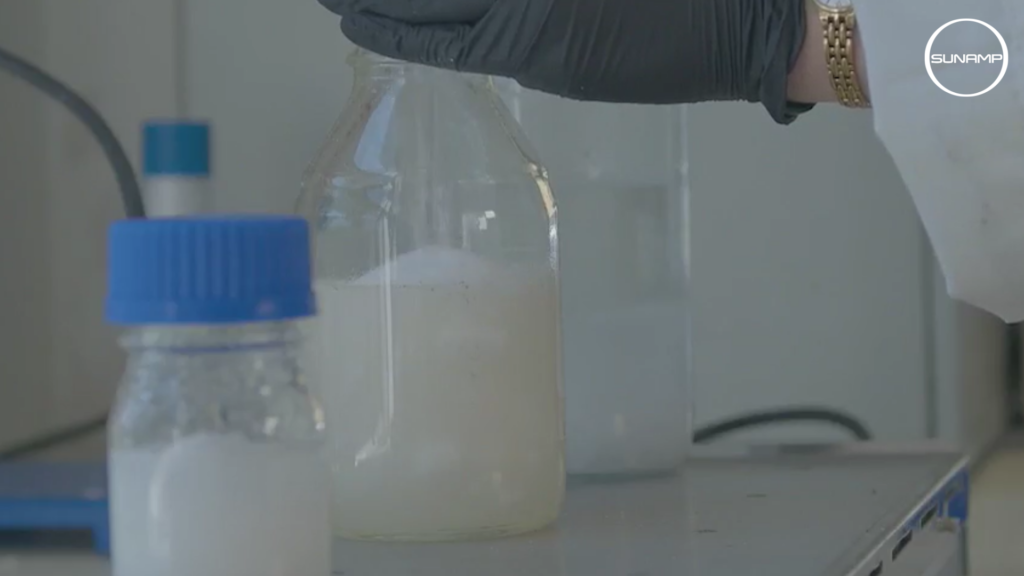
Understanding failure modes is important because they are not just technical risks. For manufacturers, they are product risks. Unpredictable PCM behaviour can affect warranty exposure, installation confidence, brand reputation and the ability to scale a thermal storage product commercially.
1. Reliable energy release: nucleation, supercooling and crystal growth
Some PCMs can remain liquid when cooled below their expected crystallisation temperature/melting point. This is known as supercooling or subcooling. If nucleation is unreliable, the material may not release heat when the system needs it.
A PCM is only useful as a storage material if it can both absorb and release energy predictably.
This is especially important for inorganic PCMs such as salt hydrates, where controlling crystallisation is central to reliability. However, nucleation is one part of the story. A material may nucleate at a suitable temperature and still deliver poor heat output if the crystals grow too slowly.
Crystal growth rate is difficult to quantify in isolation because it depends on the material, the operating conditions and the system design. In practice, one useful system-level measure is the maximum power that can be extracted from the unit while the PCM is being cooled and crystallised. This gives a clearer indication of whether the stored heat can be released at a useful rate for the application, or for a cooling PCM, whether the material will be fully charged (frozen) during a typical charging window.
2. Long-term reliability: preventing phase separation
Over repeated cycles, some salt hydrate PCMs can separate into components, such as different hydrate forms. If that happens, the PCM no longer behaves like the original formulation. Transition temperature may drift, latent heat capacity may fall, nucleation may become less likely and long-term reliability may suffer.
This kind of behaviour may not appear in a short bench test. It may also be easier to reverse at small scale, giving false confidence in the stability of the material. But it is critical in a scalable commercial product, where condition may cause the PCM to change behaviour over time.
3. Water content is another key parameter for performance.
In salt hydrate PCMs, too little water can cause incomplete hydration. That reduces energy storage capacity and may result in undesired hydrate forms. Too much water can decrease the likelihood of nucleation, broaden phase transition temperatures and reduce energy storage capacity by dilution.
Even in organic PCMs, absorption of water from the surroundings may cause hydrolysis, degrading the PCM and potentially creating degradation products that are incompatible with heat battery components.
For this reason, sealing is a key design principle in a heat battery system. After manufacture, the unit needs to be sealed against moisture gain and loss, so the water content of the PCM remains consistent after it has been measured and turned to an acceptable quality control standard during the manufacturing process.
4. Materials compatibility and system safety
A PCM does not sit in isolation. It is in contact with metals, polymers, seals, coatings and heat exchanger surfaces. It also contacts the headspace inside the heat battery, where gases may be present. The PCM may behave differently in this region because of those gases.
If the PCM, or the PCM and headspace gas combination, is incompatible with system materials, the result can be corrosion, degradation or product failure.
This is why compatibility testing must consider the full product environment, not just the PCM in isolation. It is not enough to ask whether a PCM is salt-based or organic. PCM thermal storage manufacturers need to ask whether the selected material, containment system and operating conditions are compatible over the full expected life of the product.
Why standard PCM specifications do not cover everything when it comes to selecting a heat battery
A PCM data sheet is useful. It typically gives transition temperature, latent heat, solid and liquid specific heats, thermal conductivity, density and hazard classification.
But it cannot, on its own, tell a product manufacturer how that material will behave inside a thermal storage product.
What it doesn’t give you and what product manufacturers need to know:
- cycle stability at operating conditions in a working system, not lab conditions
- crystallisation reliability at scale
- nucleation reliability data: how consistently and quickly the material can release heat
- materials compatibility with relevant metals, plastics, seals and coatings
- shelf life and changes in behaviour under real storage conditions
- volume expansion during melting; PCMs can expand by 10% to 20% when melting (with the exception of ice). Ensuring the container allows for 8% to 15% void volume in the solid state to prevent over pressurisation.
- Viscosity is another factor that may not be obvious from headline specification values. Some PCM formulations are thickened to help manage phase separation, but this can introduce other trade-offs. A thicker PCM may reduce convective heat transfer, affect nucleation performance and slow crystal growth. It can also make the material harder to fill consistently into a heat battery or thermal store, increasing the risk of voids, poor contact with the heat exchanger or filling constraints that compromise heat exchanger performance.
For product manufacturers, this is a useful reminder that solving one PCM challenge can create another if the material is not considered as part of the full system.
- supercooling behaviour and nucleation control; some inorganic PCMs (like salt hydrates) experience supercooling, where the liquid fails to freeze at the right temperature. Knowing whether the PCM includes nucleating agents (additives) to force proper crystallisation is important to overall system performance.
- manufacturability and quality control at scale
The point here is that the same PCM may not create the same value in every product. Its value depends on how it is integrated into the heat exchanger, control logic, end-user case, installation route and wider product architecture.
A data sheet can tell you what a PCM is, but not what it does. It cannot reliably tell you how it will behave inside a thermal storage product, or whether it can become part of a manufacturable, certifiable and commercially viable system.
Why useful energy matters more than headline latent heat numbers
Many PCM comparisons focus on latent heat per kilogram or per litre. For OEM products, useful energy, or accessible energy, is often more important.
Useful energy depends on:
- the actual temperature range available in the product and application
- whether the PCM fully melts and crystallises during each cycle
- how much space is available
- heat losses during storage
- how much energy can be extracted at the required application temperature
- how quickly energy can move in and out of the material
A PCM with strong latent heat numbers may still underperform if the system cannot access that energy within the required operating window, time frame or output temperature.
The right PCM is not simply the material with the highest number on paper. It is the one that supports the product application.
A heat pump manufacturer, refrigeration equipment maker, HVAC system integrator or industrial equipment manufacturer may each need a different balance of storage capacity, output rate, form factor, charge time, material compatibility, cost and manufacturability.
That is why useful energy should be understood in the context of the full product, not just the material.
Why PCM thermal storage depends on heat exchanger design
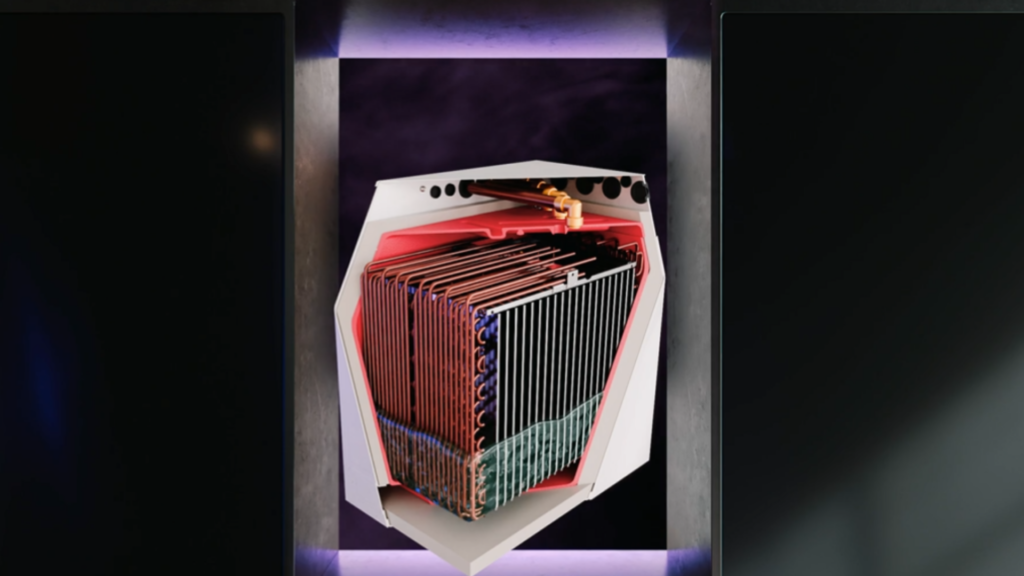
Thermal battery performance depends on both energy capacity and rate of heat transfer.
Capacity refers to the total amount of heat or cold the material can store within the system. Rate of heat transfer describes how quickly that stored energy can be transferred into or out of the product during operation.
For product manufacturers, this depends on PCM thermal conductivity, heat exchanger design, surface area, flow path, PCM layer thickness, charge and discharge times, nucleation behaviour, crystal growth rate and control strategy.
Ideally, the heat exchanger should add heat at the same rate that the PCM can transfer heat away from the heat exchanger during charging. It should also extract heat at the same rate that the PCM generates heat during crystallisation, taking into account nucleation and crystal growth rate.
In reality, there is usually a bottleneck. Either the heat exchanger can move heat faster than the PCM can accept or release it, or the PCM can provide more heat than the heat exchanger can use.
In theory, each PCM and application would have a heat exchanger designed specifically around its material behaviour, operating window and required charge/discharge rate. However, producing a heat exchanger design for every PCM and application is time and resource intensive.
A more practical approach is to use a proven system design that can work with different PCMs, then adapt the controls to match the application. This is how Sunamp’s Thermino platform works today: a standard Thermino design can be used with different PCMs. In many cases, this means the heat exchanger has more capacity than the application strictly needs, with controls used to manage charge and discharge behaviour.
That approach gives flexibility, but it also has trade-offs. A more powerful heat exchanger can be more expensive, so the balance between performance, control and cost has to be considered carefully. As product development continues, this may change.
To date, changes to the heat exchanger have generally been driven by system requirements rather than the PCM alone. This reinforces the central point: PCM selection, heat exchanger design, controls and system requirements all need to be considered together.
Engineering backwards from the application
Most PCM selection starts with a material list: choose a temperature, compare latent heat numbers, check cost and availability.
A better approach is to engineer backwards from the application.
That means starting with the product requirement first:
- What temperature must be held, delivered or protected?
- What is the charge source?
- What is the maximum charge temperature?
- What output temperature is required?
- How long must the product store energy?
- What minimum cycle performance is required?
- What is the total expected duration of the installation?
- What materials will the PCM touch?
- What safety or compliance requirements apply?
- What space, weight and manufacturability constraints exist?
- Does the OEM need a customised heat battery, a white-label product or a platform they can build into their own product?
Then the PCM, thermal store and integration route can be selected, adapted or developed around the system.
This is where Plentigrade should be understood as more than a PCM range. It is a thermal storage platform engineered from the application backwards.
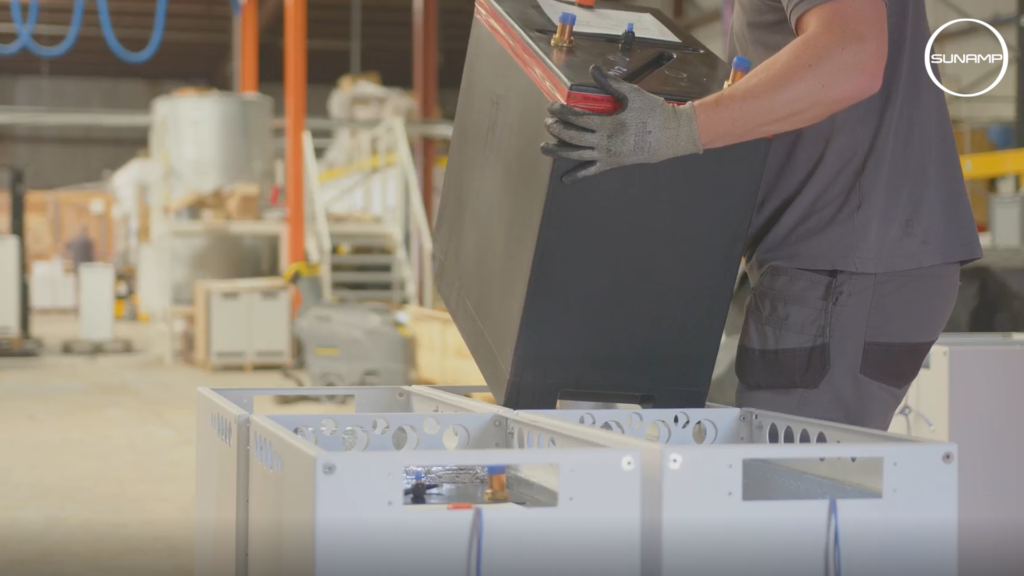
Sunamp can help OEM customers understand the operating window, material requirements and integration route needed to build reliable thermal storage into their own products.
That may mean selecting a PCM from the broader Plentigrade range, from sub-zero PCMs for freezing and cooling through to hot water, heating and higher-temperature applications. Or it may mean looking more widely at how the PCM, heat exchanger, enclosure, control strategy and manufacturing route come together in the final product.
The point is not simply to choose a temperature. The point is to match the material to a real operating window, a real product architecture and a real route to market.
How to validate a phase change material for a commercial product
Product-ready PCM development needs more than basic thermal analysis. It needs evidence that the material behaves consistently over time and under realistic cycling.
That evidence can include:
- accelerated lifecycle testing
- compatibility testing with metals and plastics
- quality control
- scale-up from lab to production
- in-situ characterisation
- independent certification
- production and manufacturing experience
- real product deployment, not just lab validation
This is where Sunamp brings together materials science, engineering, physics and chemistry through the Plentigrade thermal storage platform.
Alongside our in-house development and testing programmes, Sunamp uses specialist research facilities such as Diamond Light Source, the UK’s national synchrotron, for deeper material analysis. Its high-intensity X-rays allow researchers to observe crystallisation and phase change as they happen inside a sample, revealing how the crystal structure behaves during repeated heating and cooling. This complements our internal work and supports a more rigorous understanding of nucleation and cycling stability.
Independent validation also matters, especially for product manufacturers considering whether to design a PCM into a product with a long working life.
Sunamp is the first and only heat battery manufacturer in the world to be awarded A Grade RAL Certification for phase change material and PCM products. The certification confirms the performance of flagship Plentigrade P58, with no noticeable degradation to 10,000 cycles in Thermino.
Sunamp’s in-house testing has taken P58 through 40,000 cycles with minimal degradation, equivalent to more than 55 years of hot water delivery when charged twice daily.
However, cycling performance is only one measure of durability. Long-term product performance also depends on factors such as material compatibility, sealing, storage and operating conditions, and how the PCM is integrated into the wider system.
The value for manufacturers is not only that the PCM has been tested. It is that the material sits inside a wider platform of product engineering, certification, manufacturing knowledge and field experience.
Plentigrade is a proven thermal battery platform built around patent-protected technology, production experience and the learning that comes from making commercial thermal products at scale. That means OEM customisation does not need to start from a blank-sheet R&D project.
Conclusion: Choose the PCM as part of the complete system
For OEMs, choosing a phase change material is not simply about finding the right melting point.
The better question is: what must this material do inside our product, over its full working life?
A production-ready PCM has to work within the operating window of the application. It has to charge and discharge at the required rate, release useful energy at the right temperature, crystallise predictably, remain compatible with the surrounding materials and fit the manufacturing and commercial requirements of the product.
That is why PCM selection is both a system design decision and a product strategy decision.
If you are developing a product that needs reliable thermal storage across a defined temperature band, speak to Sunamp’s materials and OEM teams about your operating window, integration route and PCM requirements.
Developing a thermal storage product?
Work with Sunamp’s materials and OEM design teams to define the right operating window, PCM requirements, system architecture and route to manufacture, building on proven Plentigrade technology rather than starting from scratch.
Summary
Before selecting a PCM for a thermal storage product, OEM customers should ask:
- What temperature do we need to hold, deliver or protect?
- What is the real operating window, not just the target phase change temperature?
- What is the charge source and maximum charge temperature?
- What discharge temperature, duration and volume are required?
- How much useful energy must be stored?
- How quickly must the system charge and discharge?
- How many cycles must the PCM perform?
- What is the total expected duration of the installation?
- What metals, plastics, seals, coatings or headspace gases will the PCM interact with?
- What safety, flammability and environmental requirements apply?
- Can the PCM be manufactured, filled and quality-controlled at scale?
- Does the OEM need a standard product, a customised product, a white-label route or a deeper platform partnership?
- What evidence shows that this thermal storage approach has already moved beyond the lab and into real products?
Explore the custom design thermal storage service here.
Talk to our OEM team here.
Related articles