
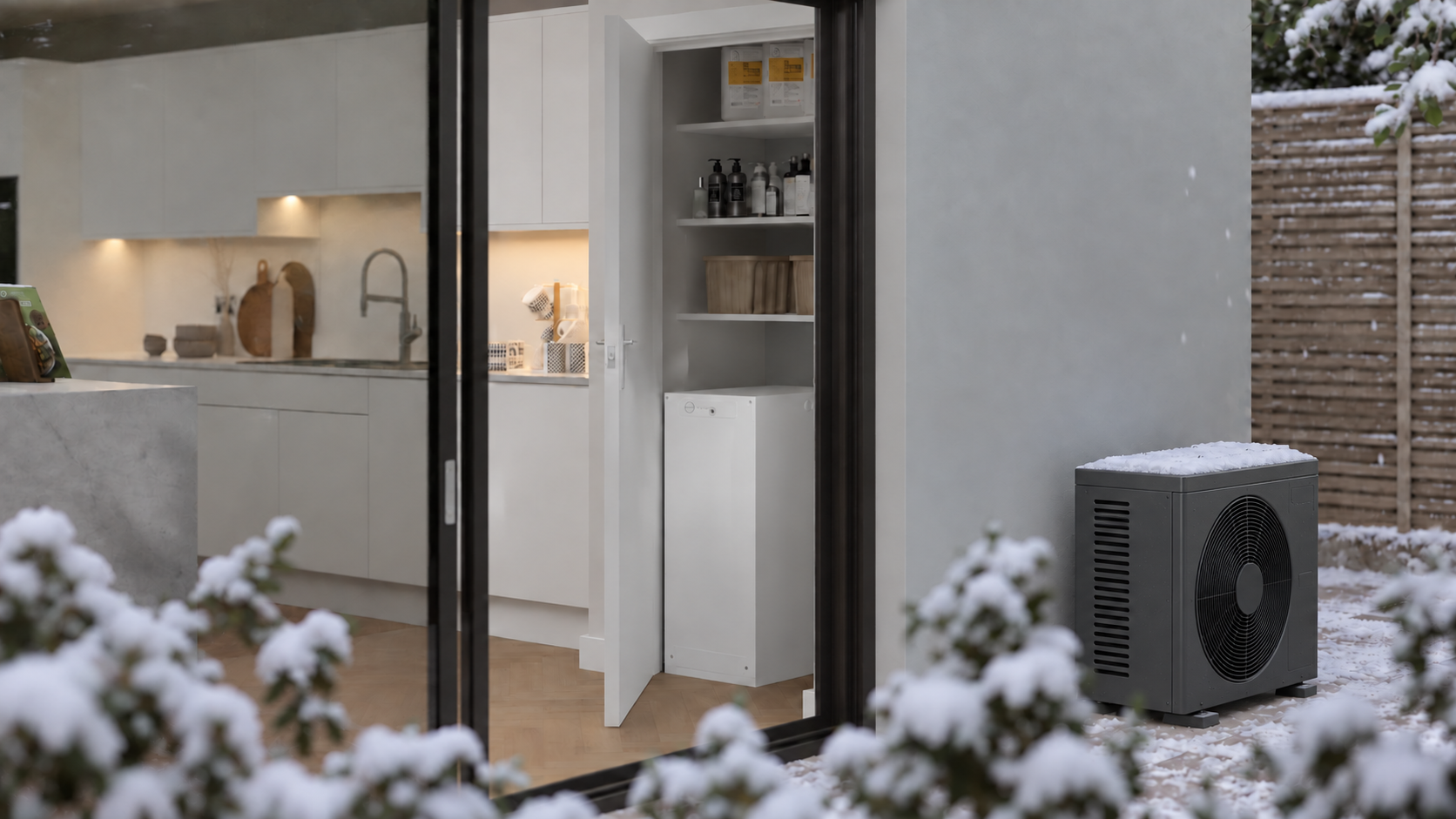
How do heat pumps work in winter? Heating, hot water and smart tariffs explained
Learn more about cold weather performance, domestic hot water, controls, thermal storage and time-of-use electricity
Yes, heat pumps can work through a UK winter when the system is correctly designed and commissioned. Air source heat pump models still extract heat from the cold winter air, although efficiency and output can fall as the outdoor temperature drops and automatic defrost cycles may run. But keeping rooms warm is only one part of it. An air-to-water heat pump also needs to charge a separate thermal store for showers and taps (at 50-55°C), i.e. at a higher temperature than the space heating circuit (which often runs at 35-45°C).
That makes hot water demand, storage, controls and charging times part of winter performance too. When the heat source, emitters (like underfloor heating or large radiators), controls and hot water storage are designed as one system, a heat pump can provide reliable comfort without needing the homeowner to be an energy expert.
How does a heat pump work when it is cold outside?
Even cold outdoor air contains usable heat. An air-source heat pump absorbs that low-temperature heat into a refrigerant, compresses it to raise the temperature and transfers it into the home. Ground-source heat pumps follow the same basic principle but collect heat from the ground, where temperatures are usually more stable through winter.
The type of heat pump matters. Air- and ground-source systems send heat to radiators or underfloor heating and can also charge a domestic hot water store. Air-to-air systems warm rooms by moving heated air but also need a separate solution for hot water. And that detail is easy to miss when people ask whether a heat pump provides both heating and hot water.
What changes when winter demand rises?
A home loses heat more quickly as the temperature difference between indoors and outdoors grows. The heat pump is then required to run for longer and work at a higher output. So overall, a well-designed home starts with a room-by-room heat loss calculation, radiators/emitters sized for the chosen flow temperature and weather compensation that adjusts the system gradually as outdoor conditions change.
Coefficient of performance (COP) just a ‘snapshot’. A COP of 3 means the heat pump delivers three units of heat for each unit of electricity used at that moment. Seasonal COP and seasonal performance factor (SPF) are better measures of performance over time because they include changing outdoor temperatures, controls, defrost and hot water production.
The DESNZ-funded Electrification of Heat Demonstration Project installed 742 heat pumps in a wide range of British homes. Its interim analysis found a median air-source system efficiency of 2.44 on the coldest observed days, when mean daily temperatures fell as low as -6°C. The project also reported a median annual SPF of 2.80, while also finding significant variation between systems. Installation and commissioning still make a difference.
What happens to heat pumps during a defrost cycle?
Moisture can freeze on the outdoor coil of an air-source heat pump in cold, damp weather. The unit will then switch to defrost mode and reverse its refrigerant cycle for a short time to use heat and melt the frost. Meanwhile, indoor space heating may pause briefly, and you may notice water or vapour around the outdoor unit, which is normal. The advice is to not chip ice from the coil. Persistent heavy ice, a blocked fan, failed drainage or repeated fault codes should be checked by the installer. Keeping the unit clear of leaves, snow and stored items also protects airflow.
Heat pumps generally work best with steady, weather-compensated operation rather than repeated bursts from cold. The exact setback and control strategy should follow the commissioned design for the property.
Another winter detail is easy to overlook: the insulation around water pipes between an outdoor monobloc heat pump and the home. HPA UK said that non-compliant external pipework insulation is the biggest ‘non-conformity’ found in MCS audits. Gaps, exposed fittings or damaged protection can increase heat loss. Before winter, it’s essential to check the insulation for splits, gaps or water damage and ask the installer to repair defects rather than altering the system yourself.
There has been de-growth in latest UK heat pump figures, but that needs context
The latest DESNZ deployment statistics estimate that 20,895 MCS-certified air-to-water and ground or water source heat pumps were installed in existing UK homes in the first half of 2026. That was 22% lower than the same period in 2025. However, 2025 retrofit volumes were still 9% higher than 2024 and more 4.5x times the 2020 level. The numbers exclude new build homes and retrofit installations that are not MCS-certified.
Other datasets measure different things. MCS recorded more than 60,000 certified heat pump installations in 2025, while HPA UK recorded 125,037 factory gate heat-pump sales, up 27% y-o-y. HPA UK also reported that sales for heating buildings grew 5% year on year in Q1 2026 and that new build installations were 38% higher.
Recent Which? research helps explain why uptake can slow even when technology works. In a survey of 1,004 UK homeowners who had researched a heat pump but decided against it or remained undecided, 33% said there were too many long-term uncertainties, 29% felt the investment was too much of a gamble and 54% struggled to find clear, reliable information about running costs. That points to a ‘confidence gap’, which isn’t the same as technology gap. Homeowners need a clear picture of the complete winter experience: room comfort, hot water capacity, controls, likely running costs, installer responsibility and what happens if something goes wrong.
The overlooked part of winter performance is hot water
Domestic hot water is greatly “under considered” in discussions around heat pumps in winter
Many guides explain how a heat pump extracts heat from cold air but stop from explaining how the same system supplies showers, baths and taps, which is the biggest energy load in a household.
An air source heat pump charges a separate hot water store. The target temperature for domestic hot water is often higher than the flow temperature used for space heating, so the system may switch into a “hot water priority mode” and temporarily pause room heating while it recharges the store. Most heat pumps operate this way. But a well-designed system manages this sequence without a noticeable loss of comfort.
It is important to size the thermal store for household demand, including occupancy, shower flow, baths, simultaneous use and recharge time, not just bedrooms. ‘Hot water on demand’ means the store supplies taps immediately, not unlimited hot water; it can run out if use exceeds capacity and recharge.
Space needed for a thermal store is also a common retrofit issue. The ‘Electrification of Heat’ project found that 81% of the homes needed a new thermal store, usually because a combi boiler had left no existing store or the original cylinder coil was unsuitable. In 33 flats, a Sunamp heat battery was installed instead of a hot water tank because space was limited. If you are moving from a combi boiler to a heat pump, the storage decision should be made early rather than treated as an afterthought.
Can smart tariffs and solar PV help in winter?
They can, but tariff choice must fit the home and the system. Energy Saving Trust’s Flexible futures report modelled (using half hourly simulation model) more than 1.7 million combinations of air-to-water heat pumps, solar PV, electrical batteries, household patterns and tariffs. Its main finding was that tariff choice and system integration can determine whether the same technology lowers or raises bills.
For a heat pump without solar PV or an electrical battery, the representative median result ranged from an annual saving of about £210 on the modelled ‘Dynamic tariff’ to cost increases of ‘£90 to £250’ on some other tariffs. These were illustrative model outputs based on 2024 tariffs, defined household assumptions and a median whole system SPF of 2.76. They are not a savings forecast for an individual home.
Electricity prices and tariffs continue to change. From 1 October 2026, VAT on domestic electricity was reduced from 5% to 0% for the 2026/27 financial year. That lowers domestic electricity bills relatively but does not make any one smart tariff right for every household.
So the EST’s modelled savings are based on 2024 prices, not forecast today.
The report also exposes an important gap. Its performance boundary included heating and hot water, and its modelled installation cost included a dedicated cylinder, but thermal hot water storage was not assessed as a flexibility technology.
That’s where the hot water design deserves more attention. A well‑matched PCM store separates when energy is collected from when taps or showers are used, shifting some demand into cheaper periods or times of excess solar without changing how the household behaves.
The combination of a heat pump, solar PV, electrical battery storage and the right tariff can be powerful when the components and controls work together. It is still important to compare current import and export rates, charging windows, control compatibility and likely winter demand. Thus, a smart tariff is not a saving in itself. The value comes from using it well.
Why Thermino works well with heat pumps, solar PV and smart tariffs
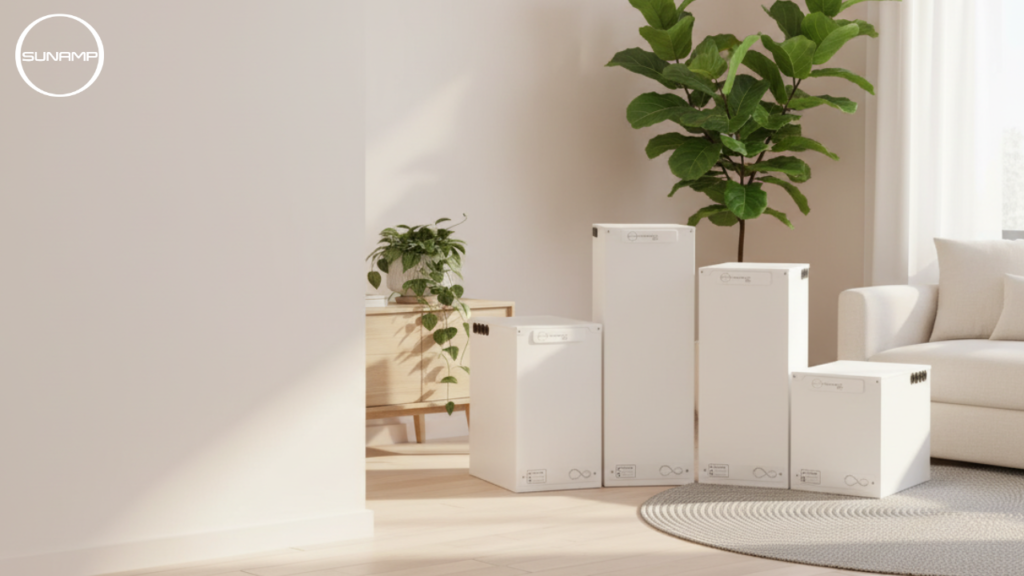
Sunamp Thermino is the domestic thermal store for hot water within a heat pump system. Instead of storing a large volume of hot water, it stores heat in high energy density patented Plentigrade PCM technology.
When a shower or tap is opened, fresh mains water passes through Thermino and is heated instantaneously using the energy stored in the phase change material. This is made possible by the award-winning finned-tube heat exchanger technology, which transfers heat rapidly enough to provide high-flow-rate, mains-pressure hot water.
Thermino offers several practical advantages over a traditional hot water cylinder. It is up to 4x smaller than an equivalent cylinder, which can make the difference between a heat pump project being viable or not. Limited space for a dedicated hot water cylinder is a common reason installers have to turn projects away, but Thermino has enabled air- and ground-source heat pump installations in complex homes across the UK.
Also, because Thermino does not store a large volume of domestic hot water for long periods, it avoids the need for the routine, energy-intensive anti-Legionella cycles associated with hot water cylinders. This can help to reduce water-heating costs further.
Additionally, Thermino heat batteries combine a high amount of stored heat with ultra low (up to 75% lower) standing heat losses, which means useful energy can be stored for later use without much of it escaping into the surrounding space, unlike a traditional cylinder.
These characteristics make the heat battery particularly valuable in homes using solar PV or time-of-use electricity tariffs. The heat battery can be charged when electricity is cheaper or when surplus solar generation is available, then hold that heat for days for showers & tap water use. This separates the time when energy is generated or purchased from the time when hot water is used.
For example, a household could charge Thermino during a lower cost overnight tariff window and use the stored heat during the morning peak. Surplus solar electricity generated during the day could also be stored as heat for hot water use later. One homeowner with a solar-powered Thermino reported that a full charge could meet the household’s normal hot-water needs for about a week before recharging. Based on the unit’s estimated heat loss, the homeowner calculated that, if no hot water were used, there could still be enough stored energy for a shower around 20 days later.
Thermino therefore provides more than a compact and energy-efficient alternative to a hot water cylinder. Its energy density, low heat loss, rapid recharge capability and ability to store heat for later use can help the heat pump, solar PV, controls and electricity tariff work together as one flexible system.
Correct model selection, hot water sizing, heat pump compatibility, control settings and commissioning remain essential. Thermino xPlus can be used with listed compatible heat pumps through the appropriate Optimino key, with matching configurations available for systems that also use solar PV.
Optimino key guide for installers
Application |
Optimino key |
Installer action |
Thermino xPlus with a compatible heat pump |
Heat pump brand-specific key ending ‘01’ |
Match against the heat pump model and key on the live compatibility page. |
Thermino xPlus with a compatible heat pump and solar PV |
Matching brand-specific key ending 02 |
Use the paired PV key and follow the manufacturer’s wiring instructions. |
Thermino xPlus with a boiler |
VF01 without PV or VF02 with PV |
Use the boiler configuration and current technical notes. |
Thermino ePlus with solar PV |
PV02 |
Confirm diverter compatibility and follow the current wiring and settings manual. |
Always use the official Optimino resources at the point of specification and installation.
Design the whole system for winter
The question is no longer simply whether a heat pump works when it is cold. UK field evidence shows that suitable systems can. The useful question is whether the complete installation has been designed to keep rooms comfortable, prepare enough hot water, manage defrost and use electricity at sensible times.
Planning a heat pump installation or reviewing your hot water storage?
Find a Sunamp-approved installer or stockist who can help size the right Thermino and confirm compatibility with your heat source.
Quick questions about heat pumps, hot water and winter
Do heat pumps work when the temperature falls below freezing?
Yes. Suitable heat pumps can continue operating below freezing, although their output and COP may reduce as the outdoor temperature falls. Air source units may also run automatic defrost cycles to remove ice from the outdoor coil.
Why does hot water storage matter during winter?
An air to water heat pump often needs to heat the home and prepare hot water. Hot water is normally produced at a higher temperature than space heating, so the system may briefly pause room heating while it charges the store. Correct sizing, controls and recharge time help the system manage both jobs without affecting comfort.
Does a heat pump need a hot water cylinder?
A heat pump usually needs a separate store for domestic hot water, but this does not have to be a conventional cylinder. A compatible thermal store such as a Sunamp Thermino heat battery can store heat in phase change material and use it to heat fresh mains water when a tap or shower is opened.
What are the advantages of Thermino compared with a hot water cylinder?
Thermino can be up to four times smaller than an equivalent hot water cylinder, depending on the model and comparison. It can also have up to 75% lower standing heat losses, helping more of the stored energy remain available for use. Thermino heats fresh mains water as it passes through the unit, rather than storing a large volume of domestic water, and can provide high flow rate, mains pressure hot water through its advanced heat exchanger.
Can Thermino help make a heat pump installation possible in a smaller home?
Yes. Limited space for a hot water cylinder can prevent some heat pump projects from going ahead. Thermino stores a high amount of heat in a much smaller footprint, which can make installation possible in flats, compact homes and properties where a conventional cylinder would take up too much usable space.
Does Thermino need a Legionella heating cycle?
Thermino does not store a large volume of domestic hot water. Fresh mains water is heated as it passes through the unit, so it avoids the routine, energy intensive Legionella heating cycles associated with stored water cylinders.
Can Thermino provide hot water on demand?
Yes. When a tap or shower is opened, fresh mains water passes through Thermino and is heated using the energy stored in its phase change material. Its award winning heat exchanger is designed to transfer heat rapidly and deliver high flow rate, mains pressure hot water. Like any thermal store, it must be correctly sized for the household’s expected demand.
Can Thermino work with solar PV and smart tariffs?
Yes. A compatible Thermino system can store heat produced using lower cost electricity or surplus solar PV, then hold it until hot water is needed. This separates the time when energy is generated or purchased from the time when it is used, helping the heat pump, solar PV, controls and electricity tariff work together.
Why do low heat losses matter with smart tariffs and solar PV?
Moving energy use to a cheaper tariff window or a period of surplus solar generation is less useful if much of the stored heat escapes before it is needed. Thermino’s low standing heat losses help preserve that energy for showers, baths and taps later in the day or over the following days.
What happens during a heat pump defrost cycle?
In cold, damp weather, ice can form on the outdoor coil of an air source heat pump. The unit will briefly reverse its refrigerant cycle to melt the ice. A short pause in space heating, along with water or vapour around the outdoor unit, is normally part of this process.
Should I turn my heat pump off at night?
Heat pumps usually work best through steady operation with weather compensation rather than repeated bursts of heating from cold. The settings established when the system was commissioned should take priority because every home and installation is different.
Is financial support available for installing a heat pump?
The Boiler Upgrade Scheme in England and Wales currently offers £7,500 towards eligible air source, ground source and water source heat pumps. Eligible properties not connected to the gas grid may receive £9,000 towards an air to water or ground source heat pump until 31 March 2027. The installer normally applies on the property owner’s behalf. Check the latest Ofgem guidance before relying on the grant amount or eligibility requirements.