In Kitakyushu City, Japan, IHI Corporation successfully demonstrated how compact thermal storage can unlock the true potential of industrial waste heat. By capturing surplus heat from a soap manufacturing plant and piping it to a neighbouring chemical factory, the project shows how Sunamp’s Central Bank Mini can profitably transform previously wasted energy into a reliable, low‑carbon heat supply.
Heat that once escaped from Shabondama Soap Co., Ltd.’s boiler is now stored in a Central Bank Mini thermal battery and transported underground to Hirota Chemical Industry Co., Ltd., where it is used to warm chemical materials for production. The result is a powerful example of how thermal storage enables waste heat reuse, reduces infrastructure costs and opens the door to new Heat as a Service business models.
The challenge
In Kitakyushu’s dense industrial zone, two factories sat side by side, one discarding valuable heat, the other relying on electricity‑intensive processes to warm chemical drums.
The project needed a solution that could:
- Capture intermittent waste heat
- Store it efficiently with minimal losses
- Bridge the timing gap between heat generation and heat demand
- Transfer energy reliably between two independent industrial sites
This required a compact, high‑performance thermal storage system capable of delivering predictable, dispatchable heat to transfer through an underground pipeline.
The solution: Central Bank Mini
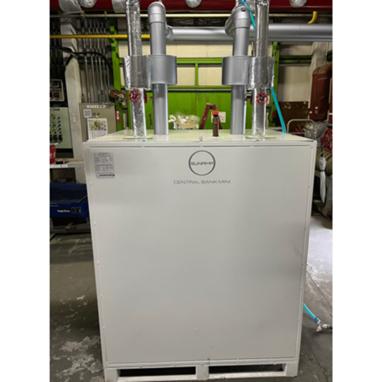
Sunamp’s Central Bank Mini using Plentigrade advanced phase change material (PCM) technology was installed at the Shabondama Soap facility to store recovered boiler heat.
How it works:
- Waste heat from the soap factory boiler is captured via a heat exchanger.
- The Central Bank Mini stores up to 80 kWh of thermal energy with exceptionally low standing losses.
- Heated water is transported through a 70‑metre underground pipe to Hirota Chemical’s site.
- The heated water then warms plastic drums containing chemical materials before they re‑enter production.
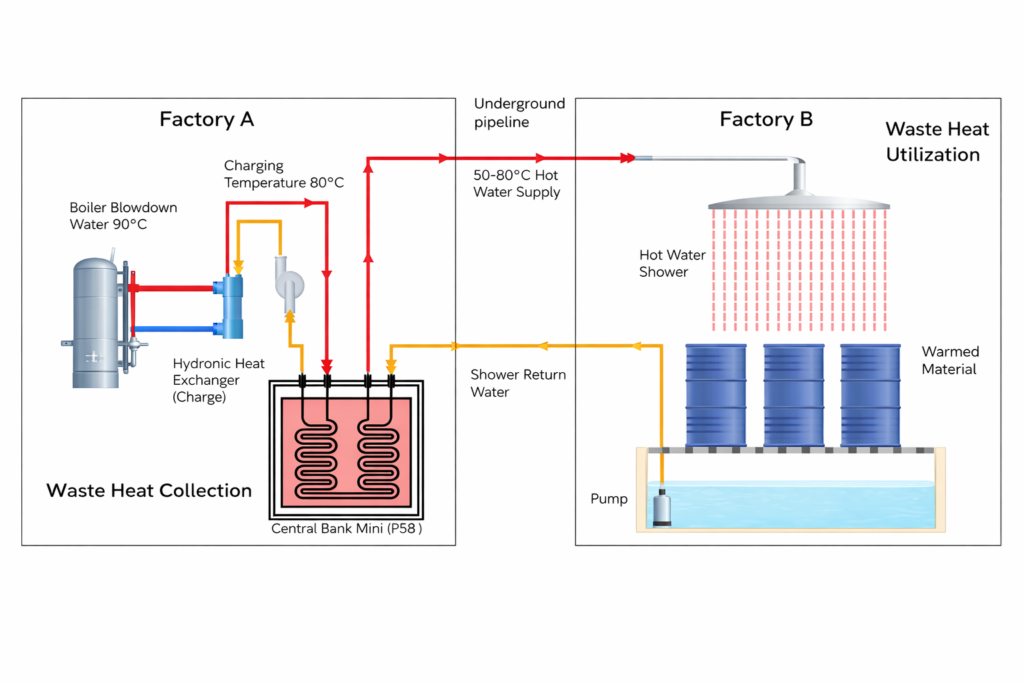
By decoupling heat supply from heat demand, the system delivers consistent, high‑value heat even when the soap factory’s boiler output fluctuates.
The results
Following testing and operational modelling, IHI confirmed strong technical, commercial and environmental performance. Key outcomes were:
- ~30% reduction in initial equipment costs compared to pre‑trial estimates
- CO₂ payback in under one year, meaning manufacturing and installation emissions were offset within the first year of operation
- Long‑term operational savings and immediate climate benefits
The project proves that compact thermal storage can make waste heat recovery both economically and environmentally compelling.
Enabling heat as a service
The demonstration also validated the technical foundation for Heat as a Service models, where thermal energy can be supplied between independent companies via third‑party operators.
“This could mark a major leap toward turning waste heat into profit, with roughly 60% of industrial heat currently going unused. At the core of this project is Sunamp’s Central Bank Mini, which helps adjust the timing difference between heat demand and supply. We intend to test this as a proof of concept for a heat‑as‑a‑service business model.”
Hiroyuki Otsuka, Director of Business Development at IHI Corporation