
What industrial specifiers need to know
The pressure on energy management for manufacturing has intensified dramatically. The Food and Drink Federation’s (FDF) latest State of Industry report shows business confidence has fallen to its lowest level since the 2022 energy crisis, with energy price rises expected to push production costs higher.
In March 2026, the FDF reported that production costs across the UK’s £42 billion food and drink manufacturing sector jumped 4.4% on average in 2025, rising to 5.3% for smaller producers.
Then in April 2026, the FDF revised its food inflation forecast to at least 9% by the end of 2026, citing rising energy costs and geopolitical disruption to gas and oil markets as key drivers.
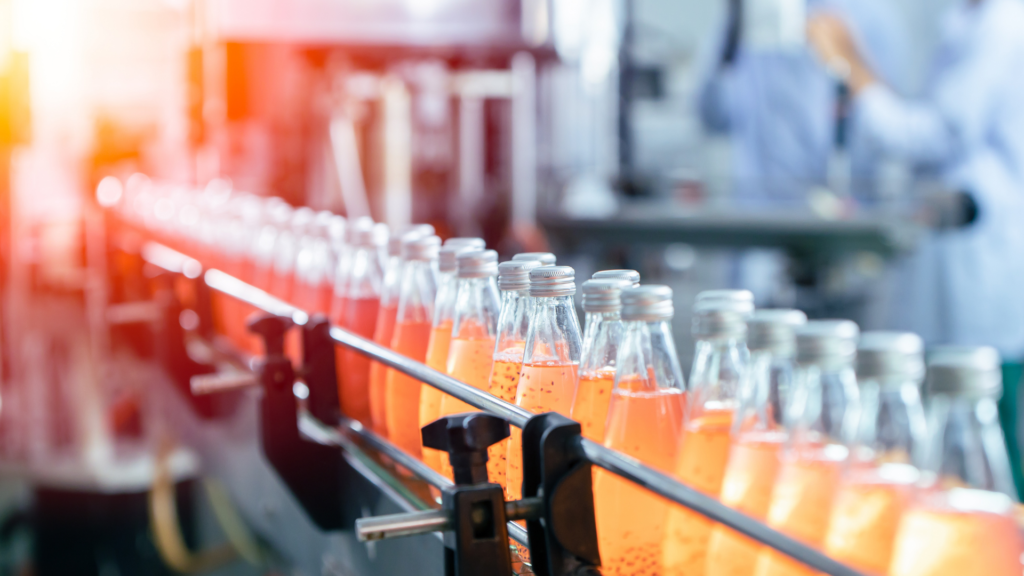 Business confidence among food manufacturers dropped to -64% in Q1 2026
Energy is embedded in every stage of food and drink manufacturing, from mashing, boiling and pasteurisation to CIP, refrigeration and packaging.
Why the Food & Beverage sector is now considering thermal storage as a part of the structure
The International Energy Agency identifies food manufacturing processes as part of a wider group of less energy-intensive industrial sectors where low-temperature heat is a major opportunity for heat recovery, heat pump electrification and thermal storage.
This category represents around 30% of total industrial energy use, and around 75% of its heat demand is below 200 °C.
Many F&B processes, from mashing, pasteurisation and cooking to CIP and washdown, do not require high-temperature steam (180-220 °C) for every duty. They need reliable, well-timed heat below 120°C.
Food and drink sites often reject useful waste heat because it is produced at the wrong time, wrong temperature, or cannot be stored efficiently.
Thermal energy storage (TES) addresses that timing problem.
A thermal energy store captures hot or cold thermal energy so it can be used later. It can support:
Security of supply: by ensuring stored heat is reliably available when business-critical production demand exceeds immediate generation capacity
Load levelling & supply balancing: by smoothing fluctuations between heat generation and process demand & leveling the demand curve, so that generators can run at optimum efficiency & reliabilty
Peak load shaving: by reducing short-term spikes in energy consumption and plant loading
Load shifting: For industrial sites, load shifting helps control operating costs, reduce peak tariff exposure and avoid penalties linked to exceeding contracted power limits. Because electricity prices and associated CO2 emissions fluctuate throughout the day, when thermal energy is generated can be just as important as how efficiently it is produced. With thermal energy storage, specifiers can decouple thermal generation from thermal demand. The system can charge when electricity is cheaper and lower carbon, then discharge when tariffs rise, cutting energy costs and emissions without compromising process continuity.
Renewable energy & waste heat recapture: by capturing surplus thermal energy that would otherwise be wasted, or by capturing intermittent renewable energy
Improved plant operational efficiency, reliability and resilience: by helping heat sources operate more steadily and effectively, reducing short cycling, minimising operational stress on equipment and providing a thermal buffer during periods of fluctuating demand or temporary supply interruption
Today, the question is no longer whether thermal storage is required on an industrial site. It is: which form of storage is right for the site?
Examining low-temperature TES (below 120 °C): buffer tank limitations and the PCM alternative
Hot water buffer tanks have long been the default thermal storage solution for specifiers in the commercial and industrial sector.
They hold sensible heat, following the familiar relationship:
Q = mCpΔT
Where:
- Q is the useful heat stored
- m is the mass of water
- Cp is the specific heat capacity of water
- ΔT is the delta, or useful temperature difference
In process heating, a buffer tank works as a thermal reservoir between the heat source and the process load. By adding extra system volume, it gives the process something to draw from when demand spikes, during washdown, pre-heating, mashing, CIP, etc.
Instead of forcing the boiler, heat pump or CHP to react instantly, the buffer tank smooths out those peaks.
On sites with multiple heat sources, such as boilers, heat pumps, CHP or recovered waste heat, a buffer tank can provide a common point where those inputs are brought together.
In practice, this is why buffer tanks are often used to reduce short cycling, helping boilers and heat pumps run in longer, steadier cycles rather than switching on and off too frequently.
But buffer tanks have limitations.
Where buffer tanks may fall short in an industrial environment
1. Footprint can be a constraint
On most manufacturing sites, available floor space and headroom is often an issue. A buffer tank must fit within production layouts, hygiene zones, access routes, pipework, lifting requirements and existing plant.
Because water buffer tanks store sensible heat (Q), their size is dictated by the usable temperature difference (ΔT).
When the useful temperature difference is narrow, each litre stores less useful heat, so the tank must grow in volume to hold the same energy. In practice, buffer vessels also operate most efficiently when they are tall and narrow (2.5m tall per 1m width), which can create access and installation challenges even where there is technically space for them.
Breweries, distilleries, dairies and prepared foods sites often operate within purposely sized buildings, older industrial buildings or compact urban facilities where expansion is difficult and every square metre is spoken for. In these environments, tank height, access and manoeuvrability quickly become limiting factors.
2. Standing heat losses increase with storage duration
A buffer tank is a hot, water-filled vessel. Even with good insulation, heat is lost over time.
Heat loss is proportional to the surface area of the buffer vessel, meaning losses rise with surface area and the temperature gap to ambient.
Following the relationship:
Q = UAΔT
Where:
- Q is the heat loss rate
- A is surface area
- U is thermal conductivity
- ΔT is the temperature gap to ambient
A high heat loss rate may be acceptable if the hot water is used straight away or is used only for smoothing short peaks. But when a site wants to store heat for longer periods, shift loads to cheaper electricity periods, or hold recovered waste heat until the next useful production step, losses become more significant.
For many sites, the value of heat storage is not just having heat available. It is keeping as much of that heat as possible until it is needed.
3. A narrow delta limits storage capacity
Water-based sensible heat storage requires a useful temperature delta above the use temperature. That means many heat sources close to the use temperature cannot store enough heat without drastically oversizing the buffer vessel.
For example, a site may want to capture heat from a chiller heat recovery unit at 65°C and use it for a 50°C washdown process at the end of a shift. In this scenario, a small 15°C ΔT is fixed in the sensible heat equation.
To expand energy storage, Q, the system needs extra m, or mass of water.
A larger buffer vessel leads to a larger surface area, which results in higher heat losses through the heat loss equation Q = UAΔT. This compounds issues with footprint and thermal losses, making buffer tanks uneconomical in some applications, or unable to hold enough useful heat before it drops.
How PCM thermal storage changes the equation
A hot water buffer tank stores sensible heat. As heat is added, the water temperature rises. As heat is removed, the water temperature falls.
Sunamp’s commercial development manager F&B, Adam Dixon says “PCM thermal storage changes this equation by adding latent heat within the ΔT. This reduces the size, and therefore the surface area and losses in this scenario. As heat is added, the PCM absorbs a large amount of energy as it changes state. During discharge, it releases that heat back again around its phase change temperature. This is why PCM thermal storage is useful in narrow delta applications. It can store useful heat around a defined temperature band, rather than relying on a large volume of water and a wide temperature difference.”
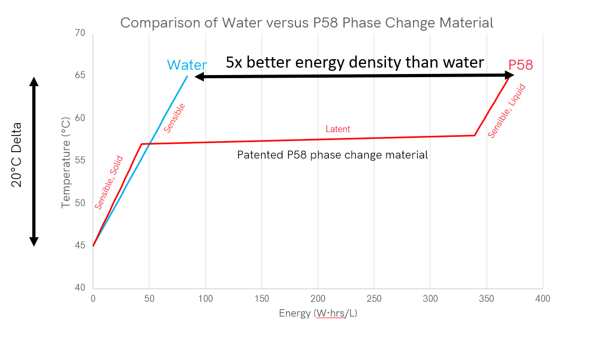
Sunamp PCM thermal storage benefits:
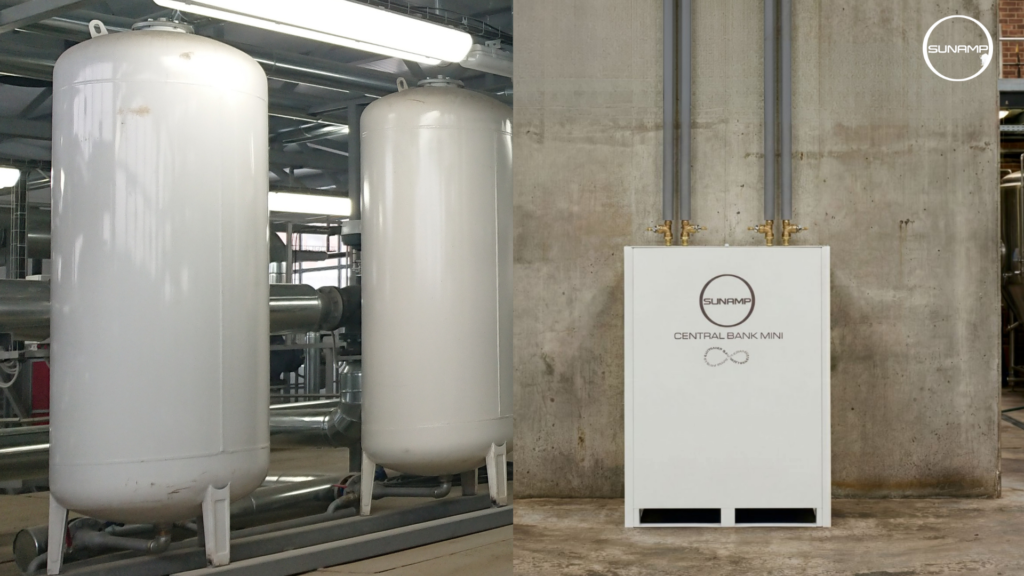 Hot water buffer tanks vs Central Bank Mini PCM thermal storage
Benefit #1: Smaller footprint
Our highly energy dense Plentigrade phase change material makes our thermal storage significantly smaller compared to an equivalent hot water tanks.
The tables below compare a 600-litre-capacity Central Bank Mini with equivalent insulated hot water buffer tanks at different temperature deltas.
T1 is the lower usable operating temperature, T2 is the upper usable operating temperature, and Delta/ΔT is T2 minus T1. Total heat is presented as modelled usable thermal energy based on PCM thermophysical properties and water sensible heat calculations.
| PCM Volume | T1 | T2 | Delta | Total Heat | Water tank equivalent | Insulated buffer tank height | Height savings using Central Bank Mini |
|---|---|---|---|---|---|---|---|
| L | °C | °C | °C | kWh | L | m | m |
| Central Bank Mini (P89) | |||||||
| 600 | 85 | 115 | 30 | 61.29 | 1750 | 2.41 | 0.91 |
| 600 | 85 | 105 | 20 | 54.00 | 2314 | 2.64 | 1.14 |
| 600 | 85 | 95 | 10 | 46.71 | 4004 | 3.17 | 1.67 |
| Central Bank Mini (P58) | |||||||
| 600 | 50 | 80 | 30 | 78.10 | 2230 | 2.44 | 0.94 |
| 600 | 50 | 70 | 20 | 69.70 | 2987 | 2.88 | 1.38 |
| 600 | 50 | 60 | 10 | 61.30 | 5424 | 3.23 | 1.73 |
| Central Bank Mini (P43) | |||||||
| 600 | 35 | 65 | 30 | 63.76 | 1822 | 2.30 | 0.80 |
| 600 | 35 | 55 | 20 | 56.83 | 2435 | 2.69 | 1.19 |
| 600 | 35 | 45 | 10 | 49.90 | 4277 | 3.02 | 1.52 |
As the useful delta narrows, the equivalent hot water buffer tank becomes larger. Central Bank Mini keeps the same useful heat storage in a much more compact form.
Benefit #2: lower losses
The comparison below shows a counterfactual water buffer tank with 100mm fibreglass insulation and leatherette covering, at 20°C ambient temperature, calculated using Q = UAΔT.
| PCM Volume | T1 | T2 | Delta | Total Heat | Water tank equivalent | Standing loss: Central Bank Mini | Standing loss: buffer tank |
|---|---|---|---|---|---|---|---|
| L | °C | °C | °C | kWh | L | /Day | /Day |
| Central Bank Mini (P89) | |||||||
| 600 | 85 | 115 | 30 | 61.29 | 1750 | 8.14% | 17.42% |
| 600 | 85 | 105 | 20 | 54.00 | 2314 | 8.66% | 21.81% |
| 600 | 85 | 95 | 10 | 46.71 | 4004 | 9.35% | 32.57% |
| Central Bank Mini (P58) | |||||||
| 600 | 50 | 80 | 30 | 78.10 | 2230 | 3.59% | 8.86% |
| 600 | 50 | 70 | 20 | 69.70 | 2987 | 3.98% | 11.73% |
| 600 | 50 | 60 | 10 | 61.30 | 5252 | 4.02% | 14.60% |
| Central Bank Mini (P43) | |||||||
| 600 | 35 | 65 | 30 | 63.76 | 1822 | 2.93% | 6.43% |
| 600 | 35 | 55 | 20 | 56.83 | 2435 | 2.63% | 7.12% |
| 600 | 35 | 45 | 10 | 49.90 | 4277 | 2.50% | 7.98% |
Standing losses are shown as the percentage of stored energy lost per day at 20°C ambient temperature.
As can be seen, the compactness of PCM-based thermal energy storage results in a lower surface area for the thermal energy store. Using Q = UAΔT, the reduced surface area A reduces the heat loss across a given temperature delta.
Sunamp thermal energy stores, in comparison, use higher quality, lower U-value insulation, which is cost effective for the compact size.
By not using water as the storage medium, Central Bank Mini also only has a charge and discharge coil, plus a pressure relief valve for the PCM, reducing the number of connections and further reducing resulting heat loss.
These design features enable Sunamp PCM thermal storage to have very low standing losses within a narrow delta.
Benefit #3: easier to manage
There are further benefits which make both installation and operation of PCM thermal energy stores easier, supporting total cost of ownership.
Less legionella risk: the only water fluid in a Sunamp Central Bank Mini is within the coils, reducing the requirement for pasteurisation management for Legionella control.
No pressure vessel directive: most water thermal buffer tanks are pressure vessels and fall under the Pressure Equipment (Safety) Regulations 2016 in the UK, or The Pressure Equipment Directive in the EU. This adds monitoring cost, risk and worry for operators, and excludes unvented water tanks from many applications. Sunamp Central Bank Mini is not a pressurised hot water vessel, making efficient thermal storage possible in more applications.
Easy access: larger water buffer tanks are tall and can be far above head height, requiring access such as ladders, platforms or scaffold to monitor and maintain. The Central Bank Mini is around 1.5m tall, making most activity accessible at normal working height.
Easier install: water buffer tanks can be a major operation to position, even when empty, due to size and shape. Central Bank Mini is compact, moveable with a forklift or pallet truck, and can be moved empty and filled in situ.
At a glance
Criterion |
Water buffer tank |
PCM thermal storage |
Storage mechanism |
Sensible heat |
Sensible + latent heat |
Best suited to |
Broad ΔT, short-term buffering |
Narrow ΔT, compact storage |
Footprint |
Increases substantially as ΔT narrows |
More compact at narrow ΔT |
Temperature during discharge |
Falls progressively |
Concentrated around PCM transition range |
Hydraulic separation |
Excellent |
Depends on system configuration |
Long-duration storage |
Greater surface-area losses as vessel grows |
Potentially lower losses due to compactness |
Space-constrained retrofit |
Can be challenging |
Strong potential fit |
Best decision factor |
Simple buffering requirement |
Space, ΔT, heat recovery, load shifting |
Where Central Bank Mini can fit on a food and beverage site
Central Bank Mini becomes a compelling choice when the site needs thermal storage in particular scenarios:
- to minimise standing heat losses over 12 to 96-hour periods
- to store heat from a heat source for use with a narrow usable heat range or delta
- to support washdown, CIP or process heat with hazard point HACCP compliant temperatures
- to reduce the space needed for useful heat storage, freeing it up for access or additional capacity
- to add storage in areas where a water buffer tank is impractical or not possible
- to build a flexible route to low-carbon process heat through installing within heat exchanger networks for future high-temperature heat pump projects
- to minimise heat gains in cold environments where buffer tanks holding hot water would radiate too much heat
- to reduce the need for long pipe runs for hot water by storing heat in situ
to capture heat and store it for reuse before it reaches the cooling tower, reducing water consumption and Legionella risk;
PCM thermal storage in practice:
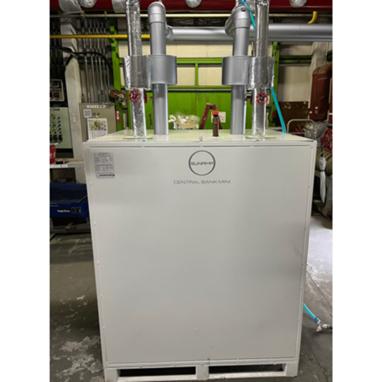
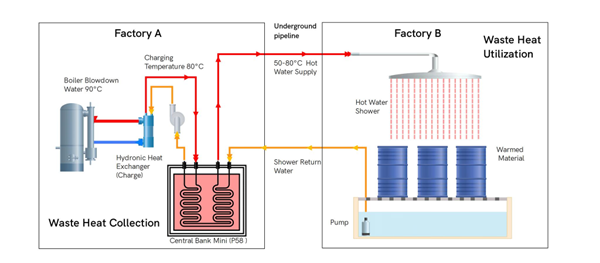
See how Japanese soap factory cuts system costs by 30% and achieves CO₂ payback in less than a year
Conclusion
Thermal storage continues to play an ever more important role in industrial heating systems. In combination with heat exchangers, buffer tanks are familiar, widely specified and useful for hydraulic separation, short-term demand smoothing and cutting heat source cycling.
However, with increasing energy costs and new high-temperature heat pump technology, sites will now need more from thermal storage: recovering low-grade useful heat, storing it with lower losses and fitting new equipment into existing plant rooms.
That is where PCM thermal storage plays a big role.
To compare Central Bank Mini against a conventional hot water buffer tank on your project, click here to speak to our commercial and industrial team.
Send us your required kWh, peak kW, flow and return temperatures, available footprint and operating profile, and we’ll help you compare PCM storage with a conventional buffer tank.
Frequently asked questions:
Why does temperature delta matter?
Temperature delta is the difference between the top and bottom of the useful operating range. Water stores heat through Q = mCpΔT. If ΔT is small, the only way to store more useful heat is to increase m, which means more water volume.
How is PCM thermal storage different?
PCM thermal storage uses phase change material to store and release heat as it changes state. This allows a PCM thermal battery to store a high amount of useful heat in a smaller volume, especially where the useful temperature window is narrow.
What do the Central Bank Mini comparison tables show?
The tables show that Central Bank Mini P43, P58 and P89 can store useful heat in a much smaller volume than equivalent insulated hot water buffer tanks. They also show lower modelled daily heat losses, especially as the useful temperature delta becomes narrower.
PCM |
Typical temperature role |
Potential industrial applications |
P43 |
Lower-temperature heat |
Waste heat aggregation, pre-heat, space heating |
P58 |
Medium-temperature hot water |
CIP, washdown, process preheat, heat-pump integration |
P89 |
Higher-temperature applications |
Steam preheat, condensate, higher-temperature process heat |
Which Central Bank Mini PCM is most relevant for food and beverage sites?
It depends on the process temperature. P43 is suited to lower-temperature duties such as low-grade waste heat aggregation and winterisation. P58 is the strongest fit for many food and beverage low-temperature hot water applications, including washdown, waste heat aggregation, process pre-heat and space heating. P89 is more relevant where higher process hot water temperatures are needed, such as around steam systems and condensate.