
Milan, Italy, 25 March 2026: Sunamp, the global leader in high performance thermal storage, today announced the launch of Central Bank® Mini, the company’s first dedicated product for the commercial, industrial and manufacturing sectors. Until now, the company has sold into the residential market, replacing traditional hot water cylinders with its Thermino range of heat batteries for hot water.
Designed to capture and realise the full value of waste heat and low carbon energy sources, Central Bank® Mini marks a major expansion of Sunamp’s proven phase change material (PCM) technology into food and beverage production, advanced manufacturing, heat networks and other heat intensive industries.
Central Bank® Mini is a compact, high efficiency thermal energy store engineered to capture, store and release heat across a wide range of industrial temperatures. Using Sunamp’s proprietary Plentigrade® PCM technology, the system absorbs heat during charging and releases it on demand during discharge, enabling businesses to recover waste heat, stabilise energy loads, reduce fuel consumption and cut carbon emissions.
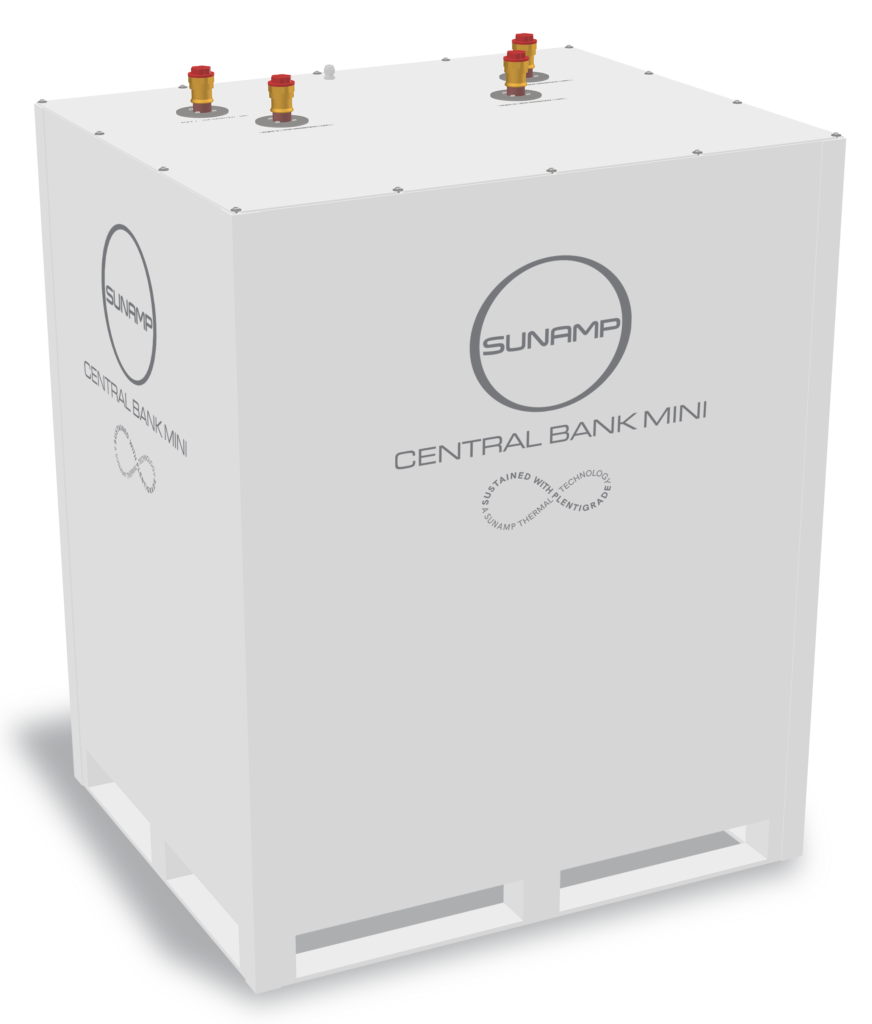
The product integrates seamlessly with the diverse heat sources found across modern industrial sites and heat networks and can harvest energy from many sources including chiller heat rejection, process cooling and heat exchange, air and flue gas heat recovery and air compressor cooling.
This previously lost energy can then be redeployed into valuable plant services, including process heating, space heating and HVAC, steam preheat and hot water generation and cooling via absorption chillers.
For food and beverage manufacturers, for example, this could mean significantly lower electricity or gas or oil use for warming, pre‑heat and essential ancillary processes and smoother, more reliable heat supply across batch operations and fluctuating boiler loads.
With three PCM options Central Bank® Mini covers charge temperatures from 50°C to 120°C and discharge temperatures from 33°C to 85°C, giving engineers the flexibility to match the store to their process requirements. Direct and heat exchanger based charge and discharge configurations allow integration with almost any industrial system.
Adam Dixon, commercial development manager responsible for food and beverage sector at Sunamp, said: “Food and beverage manufacturers face some of the toughest energy challenges in industry such as high heat demand, strict hygiene requirements, continuous operations and rising decarbonisation pressures. Central Bank Mini directly addresses these needs to provide for a more resilient, efficient and low carbon thermal infrastructure that strengthens both operational performance and sustainability outcomes.”
Sunamp’s move into industrial thermal storage builds on more than a decade of innovation in residential applications. Central Bank® Mini represents the company’s most versatile and industrially robust product to date, engineered to meet the demands of continuous duty cycles, high utilisation and complex plant integration.
Dr Maurizio Zaglio, chief commercial officer at Sunamp, said: “Industrial heat is one of the biggest decarbonisation challenges of our time. With Central Bank Mini, we are giving manufacturers a practical, high performance tool to recover waste heat, stabilise energy use and accelerate the transition away from fossil fuels. This product brings the reliability and efficiency Sunamp is known for into the heart of industrial operations, helping engineering teams deliver measurable savings and long term resilience.”
The Central Bank® Mini is a compact, modular integration that fits easily into constrained plant rooms and existing layouts.
Case study: Waste heat, reclaimed and re-used – Japanese demonstration proves the business case for turning unavoidable process heat into profit.
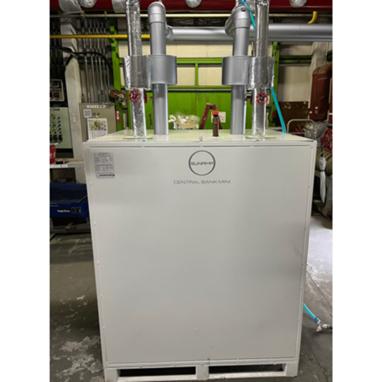
In Kitakyushu City, IHI Corporation used Sunamp’s Central Bank® Mini P58 to capture surplus boiler heat from a soap plant and deliver it to a neighbouring factory through an underground pipe. Using Sunamp’s Plentigrade PCM technology, the system stored up to 80 kWh of heat with minimal losses and supplied stable, hygienic, controllable heat on demand. The results were immediate operational savings and long-term resilience with a 30% reduction in system costs and CO₂ payback in under one year.The project also validated a future Heat as a Service model enabling shared thermal energy between independent facilities, a powerful opportunity for food and beverage clusters and industrial estates. Full story here.