Waste heat recovery in industry: capture useful waste heat now, add industrial heat pump later
How industrial (food and beverage) sites can capture and reuse waste heat today with Central Bank Mini while preparing for future high-temperature heat-pump integration
Bridging the gap between waste heat and process demand
Many industrial sites pay for heat twice: first to produce it and then again when useful heat is rejected from one process while a boiler supplies another.
Waste heat recovery captures that rejected heat and puts it back to work. In food and beverage plants, refrigeration, product cooling, pasteurisation and steam systems can reject heat that could support hot water, preheating, space heating, cleaning-in-place (CIP) or washdown.
However, where recovered waste heat is below the temperature required by another process, specifiers often consider a high-temperature heat pump for their industrial site. It can of course upgrade lower-temperature waste heat into useful process heat, helping to reduce boiler use and emissions. However, high upfront cost and project complexity can make full heat-pump integration difficult as a first step.
That does not mean waste heat recovery has to wait. Sites can reuse suitable heat directly, store it where the mismatch is timing or power, and add a heat pump later where further temperature lift is needed. This article explains how to map that phased pathway.
What is waste heat recovery?
Waste heat recovery is the process of capturing heat rejected by industrial equipment or processes and reusing it for another useful duty instead of releasing it into the air, water or exhaust. Depending on its temperature and availability, the heat may be reused directly, stored until it is needed or upgraded using a heat pump.
Start with the waste heat available
The first step is to understand the heat already available on site and how closely it matches a real process demand. Industrial sites do not need to wait for high-temperature heat pumps to become more affordable before acting on waste heat. The immediate opportunity is to identify heat that is already close to the temperature required by another process and determine whether it can be reused directly.
A practical industrial waste heat recovery project follows five steps:
- Map the sources: record the temperature, medium, flowrate, power and hours of availability for each rejected heat stream.
- Match possible demands: identify processes requiring heat and record their temperature, timing, peak kW and total kWh.
- Recover heat directly where possible: use a heat exchanger when the source and demand occur together at compatible temperatures.
- Store heat where necessary: introduce thermal energy storage when the mismatch is mainly one of timing or power.
- Upgrade heat where necessary: add a heat pump when the recovered heat is useful but below the required process temperature.
Why capture and reuse waste heat before investing in a heat pump?
Heating accounts for over 60% of industrial energy consumption. The Royal Society estimates that UK food and beverage manufacturing uses about 31.4 TWh of energy, with natural gas supplying 59%. Gas boilers account for around 65% of the sector’s thermal emissions, while many processes operate between 60°C and 130°C. This means there’s a significant waste heat recovery and electrification opportunity.
High-temperature heat pumps are important, but upfront cost and project complexity remain barriers for many sites. Mapping, capturing and storing heat using thermal storage, instead, can offer a more practical entry point: cut wasted energy now while preparing the source side for a future heat pump as the technology and business case mature.
The thermal store installed at this stage does not sit idle or become redundant once a heat pump is added later; it becomes the heat pump’s source-side buffer, feeding it a steadier supply of heat instead of the original intermittent waste stream. Sizing and connecting the thermal store with that future role in mind means the investment carries forward rather than being replaced.
A well-matched waste heat recovery system can cut purchased fuel and emissions and provide useful heat for hot water or industrial processes, meeting the specifier’s target needs. It may also reduce the amount of heat that refrigeration or cooling equipment must reject. The scale of these benefits depends on the quantity and quality of recoverable heat, operating hours and how closely the source matches a real heat demand.
Five questions for mapping the source and demand before selecting equipment
A waste heat map records source temperature, power, duration and schedule, then compares them with the temperature, timing, peak power and total energy required by possible heat uses. This can reveal direct-reuse opportunities, show whether storage is needed and define the temperature lift a future heat pump would need to provide.
Five questions provide a useful starting point:
- What temperature and power can the waste heat source provide?
- When and for how long is that heat available?
- Which process could use the recovered heat, and at what temperature?
- When does that demand occur, and what are its peak kW and total kWh?
- Could the heat be reused directly now, or would a future heat pump need to raise its temperature?
Thermal storage separates source timing and power from demand. A source can charge the thermal store gradually, while the store releases heat quickly for a short process peak such as CIP. This can reduce the need to size future heat-pump capacity around a brief demand spike and can limit unnecessary starts and stops.
How does thermal energy storage add value?
Thermal energy storage becomes useful when recoverable heat exists but cannot be used immediately. The source may operate before the receiving process, provide heat gradually while demand occurs as a short peak, or fluctuate throughout production.
Storage separates heat recovery from heat use. It allows a source to charge gradually and the stored energy to be released when the process requires it. It does not create additional heat, and it is not required where source and demand already coincide.
What Central Bank Mini can add before the heat pump
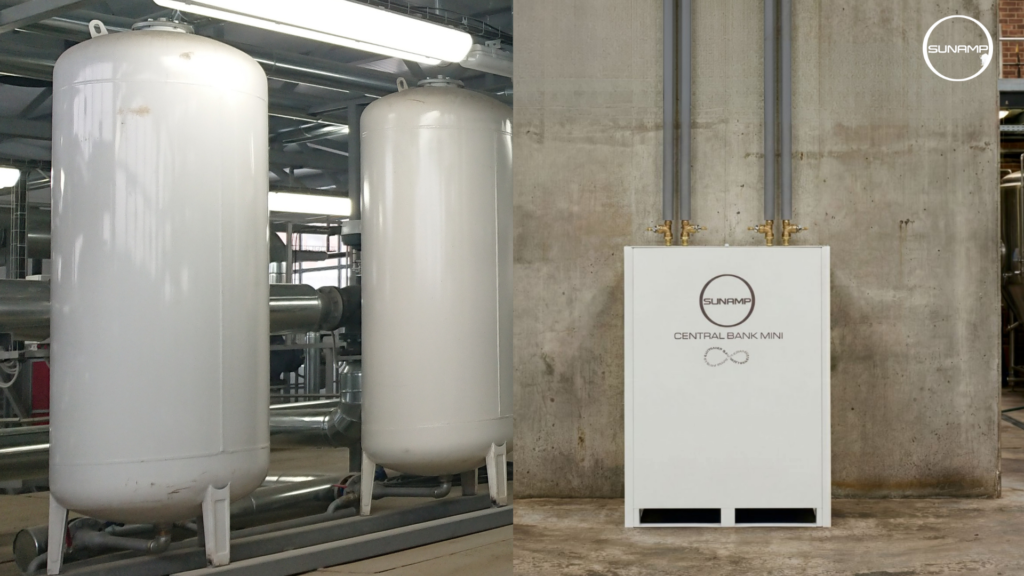
A phase change material stores latent heat as it changes phase and releases useful energy around a defined temperature. Sunamp’s Central Bank Mini thermal battery can sit after the waste heat heat exchanger, capture intermittent heat and release it later for a compatible duty.
A PCM thermal storage has a significant advantage over a hot water store, such as a buffer tank, where the useful temperature difference is narrow. At 50–60°C, a 600-litre P58 Central Bank Mini stores 61 kWh, equivalent to about 5400 litres of water. Modelled daily standing loss is 4.02%, compared with 14.6% for the insulated buffer tank. Buffer tanks can find their use in hydraulic separation and short-term smoothing. See PCM thermal storage vs hot-water buffer tanks for industrial heating for the detailed comparison.
So in a phased approach, Central Bank Mini can:
- capture useful waste heat that would otherwise be rejected;
- store it until a suitable hot water or process demand occurs;
- release heat at a defined temperature for direct reuse where the duty is compatible; and
- later provide a steadier source to the cold side of a high-temperature heat pump for heat networks.
“That future role (particularly the application temperature) should inform the initial PCM selection, heat exchanger, flow and controls design. Installing storage today does not automatically make it suitable for every future heat pump; the intended pathway (power rating/application temperature, etc.) needs to be considered from the start.”
– Adam Dixon, commercial development manager industrial at Sunamp

Where can waste heat recovery work in a food and beverage plant?
Heat recovery can work wherever one process rejects heat while another needs it. The strongest opportunities often connect cooling duties to heating duties elsewhere on the site.
Sources include refrigeration condensers, product cooling, vapour streams, ovens, fryers, compressors, pasteurisers, flue gases, condensate and flash steam. Uses include process preheating, hot water, washdown, CIP, pasteurisation, sterilisation and boiler-feed preheating.
The opportunities vary across sub-sectors:
Breweries:
Heat can be recovered from wort boil vapour, wort cooling, chiller and refrigeration systems, air compressors, condensate and primary plant. It can then support hot-liquor production, mashing, wort preheating or CIP. Smaller breweries may particularly benefit from PCM thermal storage because brewing and cleaning duties may take place on different days.
Dairies and cheese plants:
Recoverable heat may come from milk and product cooling, refrigeration, pasteurisation, whey processing, condensate and flash steam. Central Bank Mini can hold it for later reuse in batch preheating, cleaning water, CIP, vessel sterilisation or drying.
Distilleries:
Traditional distillation creates several heat recovery opportunities, including still condensers, mash and wort cooling, hot pot ale or spent wash, boiler flue gases, hotwells, condensate return, chillers and compressors. This heat can support wash preheating, mashing, CIP and boiler-feed heating. Recovering heat from still condensers may also reduce cooling-water demand.
Other food production:
Drying & baking processes, meat processors and prepared food plants may recover heat from oven exhausts, fryers, refrigeration, compressed-air systems, drying processes, hot effluent and steam processes for washdown, batch preheating, sanitation and hot water duties.
Waste heat recovery in practice

In Kitakyushu City, Japan, IHI Corporation used Central Bank Mini P58 to capture surplus waste boiler heat from a soap factory and deliver it to a neighbouring chemical plant. The system stores up to 80 kWh and transfers the recovered heat through a 70-metre underground pipe. Testing and operational modelling showed an approximately 30% reduction in initial equipment costs against pre-trial estimates and CO₂ payback in under a year. Results will vary by project, but the demonstration shows how storage can bridge a real timing and location gap between industrial heat supply and demand. Read the case study here.
Preparing for future high-temperature heat-pump integration
An industrial heat pump uses electricity to raise heat from a lower temperature to a higher one. Its coefficient of performance (COP) is useful heat output divided by electricity input. For instance, a COP of 3 means that the heat pump supplies three units of useful heat for each unit of electricity used.
One of the biggest influences on COP is ‘temperature lift’, i.e. the difference between the source and output temperatures. In general, a smaller and more stable lift makes the heat pump’s job easier. Maximum outlet temperature alone is therefore not enough to select a machine; the source temperature, operating schedule and manufacturer performance map also matter.
Once a site captures and stores waste heat, it can assess a future high temperature heat pump more accurately. Stored heat can provide a steadier cold side source and separate heat pump operation from the original waste heat schedule, allowing efficient system design with higher COPs.
One-stage high-temperature heat pump: the first option
In a one-stage design, one heat pump makes the required temperature lift. The concept below shows waste heat at about 95–110°C charging P89/P58 PCM storage. The store supplies around 85°C to a future high-temperature heat pump, which raises the circuit to about 130°C. A heat exchanger can then generate steam where the heat-pump technology and required process conditions allow.
Central Bank Mini sits before the heat pump: first to retain high-grade waste heat for a compatible duty and later to provide a controlled source when a higher-temperature process requires it.
A future one-stage system may suit a site where:
- the available source temperature is high enough;
- the target temperature sits within the heat pump’s stable operating map;
- the lift can be achieved at an acceptable COP; and
- the duty can be met without excessive cycling or electrical demand.
Storage improves the fit between source and demand, but it does not change the basic thermodynamics. The temperature lift must still sit within the heat pump’s viable operating envelope.

A possible later development: a two-stage heat pump
Where the total lift is too large for one machine, a later project may divide it between two heat pumps. This is not required for the initial waste heat capture phase.
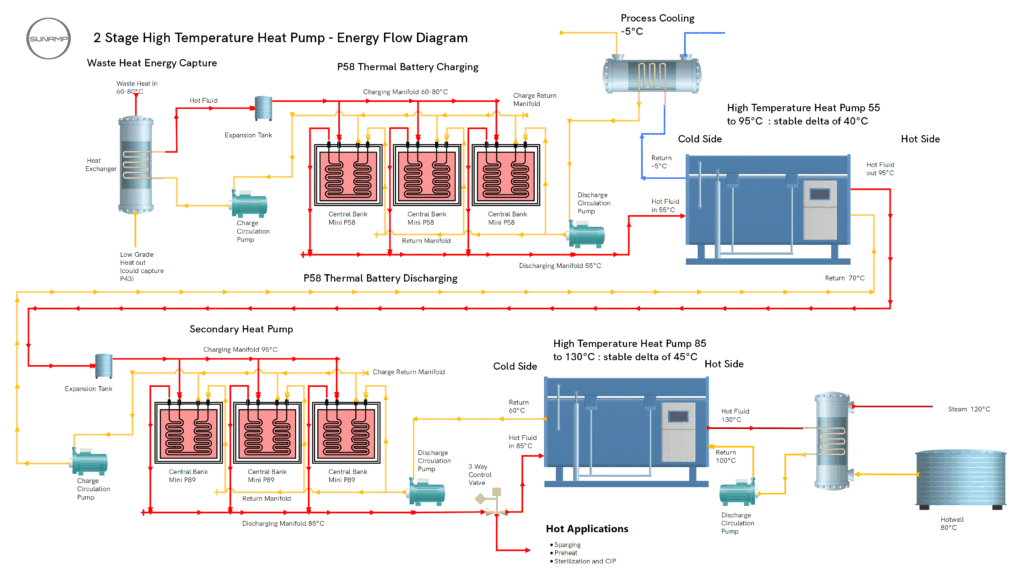
In the concept below, waste heat at around 60–80°C charges P58 storage before the first stage. The first heat pump raises the circuit to approximately 95°C. P89 storage between the stages then holds the intermediate heat before a second lift to around 130°C.
The intermediate store decouples the two heat pumps, allowing each stage to be sized and controlled around its own temperature range. The principle remains: capture waste heat first; add further stages or storage later only if the temperature lift, demand and business case justify them.
Selecting Plentigrade PCM for today’s use and the future pathway
PCM selection starts with today’s source and reuse temperatures. Future integration must also consider the temperature supplied to the heat pump’s cold side.
Sunamp Central Bank Mini is available with different Plentigrade PCM formulations. Typical discharge temperatures are around 35°C for P43, 54°C for P58 and 84°C for P89, with minimum charging temperatures of approximately 48°C, 63°C and 94°C, respectively.
P43 can support lower temperature duties, P58 warm water duties and P89 higher temperature water or high-grade waste heat. The circuit must cross the PCM’s melting and solidification window to use its latent heat, and one configuration will not suit every future heat-pump design.
Central Bank Mini arrays can be connected in series, parallel or both. Series can provide a deeper temperature draw or cascade different PCMs, while parallel arrangements support higher flow and discharge power. Final configuration depends on the individual project.

What to check before investing in a waste heat recovery system?
Before selecting equipment, the site needs a credible technical and commercial baseline. That means checking:
- how many hours the heat source is genuinely available;
- how much can be recovered after heat-exchanger and distribution losses;
- whether a compatible heat demand exists;
- the value of the gas, oil or electricity the recovered heat would displace;
- the cost of heat exchangers, storage, pumps, pipework, controls and installation;
- hygiene, materials and maintenance requirements;
- production disruption and commissioning risk; and
- electrical capacity and heat-pump costs if temperature lift is planned later.
Financial/policy support for industrial heat pump projects
Upfront capital cost remains one of the main barriers to industrial heat pump adoption. Although the Industrial Energy Transformation Fund is closed to new applications, other measures may help strengthen the business case. From April 2027, the British Industrial Competitiveness Scheme will reduce grid electricity costs by up to £40/MWh by exempting over 10,000 eligible manufacturing businesses from specific indirect policy levies. It is not a capital grant, and eligibility depends on the sector, products manufactured and site electricity use. However, lower electricity costs can improve the economics of electrifying process heat. Capital support may also be available for heat network projects, while regional finance, tax allowances and local schemes can help some businesses manage the initial investment.
Conclusion: Capture useful waste heat now and upgrade it later
A high-temperature heat pump does not have to be the first investment. Start by finding what heat the site rejects, where it could be reused and what prevents a direct connection. Central Bank Mini can capture intermittent waste heat and release it later for a compatible process, creating an immediate opportunity to reduce wasted energy and fossil-fuel demand. Designed with the future pathway in mind, the source-side store can prepare the site for a heat pump when a higher temperature is needed and the business case is ready.
Start with five inputs: source temperature, source timing, process temperature, peak power in kW and required energy in kWh. Sunamp’s industrial team can help map where Central Bank Mini could capture and reuse waste heat now while supporting a future heat-pump pathway. Connect with us here.
Get in touch
Frequently asked questions
Can Central Bank Mini deliver value before a high temperature heat pump is installed?
Yes, where recovered heat is already at a useful temperature but is available at the wrong time or power. Central Bank Mini can store that heat for a compatible process demand. Future heat-pump integration should be considered in the original temperature and system design.
Does PCM thermal storage increase industrial heat pump COP?
COP is determined by the heat pump and operating conditions. PCM can stabilise temperatures, reduce cycling and separate heat production from process peaks, helping the heat pump operate closer to its planned efficiency.
Can PCM thermal storage replace a heat pump buffer tank?
They serve different functions and may be used together. A buffer tank can provide hydronic volume, flow control and hydraulic separation, while PCM provides compact thermal storage and thermal inertia. The designer must consider the needs of the complete system.
Can a high temperature heat pump generate steam?
Some systems can supply high-temperature fluid to a steam generator. The feasible steam condition depends on heat-pump technology, refrigerant, source temperature and process pressure.