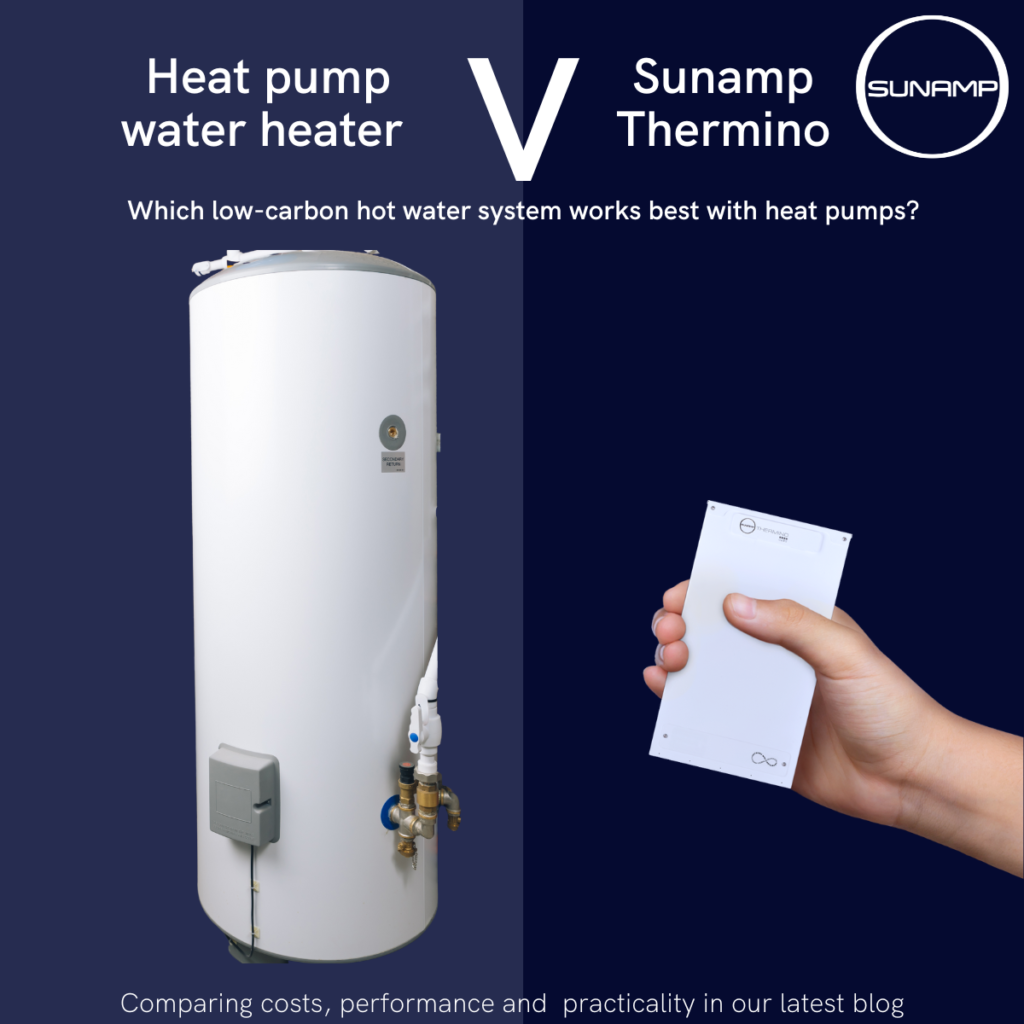
Why the installer’s recommendation matters
Heat pumps aren’t just for early adopters any more, they’re fast becoming a mainstream choice in homes across the UK. MCS recorded more than 60,000 certified heat pump installations in 2025, the highest annual total to date. The Future Homes and Buildings Standards also point new homes towards low carbon heating, higher fabric performance and solar PV.
For many of the UK’s around 23 million homes with gas boilers, especially those used to combi boiler hot water, the move to low-carbon heating will mean introducing a heat pump for the first time. It’s a design and installation decision that sits mainly with installers. But that shift also creates a practical question on almost every job: what happens to hot water storage?
A combi boiler gives customers heating and hot water from a single wall-mounted appliance. An air-to-water heat pump works differently. It heats the space heating circuit efficiently, but it does not deliver hot water on demand like a combi. The traditional solution would be to add a hot water cylinder.
Energy Saving Trust’s guidance is clear on this: heat pumps need another way to provide domestic hot water, and installers will usually fit a cylinder, but a heat battery is an option where there is not enough space for one.
That is where the installer’s recommendation matters. The hot water store can make a heat pump job possible, quick and future-ready, or it can turn something that takes up significant time, causes delays & space issues and gets cancelled.
In this article, we explore why adding a Sunamp Thermino heat battery to a heat pump quote is not only technically sound but it can also help installers sell better systems, finish installs quicker and give customers more value overall.
The hot water problem that heat pump cannot solve
We have heard this from specifiers & installers at our stand at the Heat Pump Show this year. Hot water provision becomes a serious bottleneck in many heat pump install projects because most customers simply don’t have the space to store hot water. It’s usually that there is no airing cupboard, no spare room space, a route for discharge pipework, or simply no appetite to lose storage to a large hot water cylinder: a standard 180-litre cylinder is 1200 mm tall and 550 mm in diameter.
But a hot water cylinder also means extra work at the quotation stage. Installers require G3 qualification, Building Control notification, a safe discharge route, more space than the homeowner expected, and there is also the need to carry out ongoing Legionella maintenance related checks.
In homes with finished floors, boxed in pipework, small utility rooms or no cylinder cupboard, the hot water storage can mean layout compromise or a carpentry job you didn’t price for.
Installers already carry the risk of the end customer experience. If the homeowner runs out of hot water, struggles with controls, sees higher-than-expected bills or gets told they have lost a useful cupboard, the person they remember is not the hot water manufacturer; it’s the installer who recommended the system.
None of these are dealbreakers on their own. But together, they add time, cost and complexity to a job that’s still unfamiliar to many homeowners, i.e., installing heat pump technology.
What changes when you quote a Thermino instead
Sunamp’s Thermino heat battery stores heat in a phase change material (PCM) rather than in water. What that means practically for an installer:
No G3 required
Because Thermino stores a very small volume of water internally, it avoids the same G3 certification route that applies to larger unvented cylinders. Approved Document G states that water heaters with a capacity of 15 litres or less and appropriate safety devices will generally satisfy G3(3).
That helps remove certification/qualification dependency from the job. For smaller teams, this also becomes a practical advantage. Sunamp-certified installers are able to complete multiple Thermino install jobs within a day.
No discharge pipework
Another time-consuming bit about fitting an unvented cylinder in a retrofit is routing the tundish and discharge pipe to a safe termination point outside. Thermino doesn’t need this.
Up to 4x less space
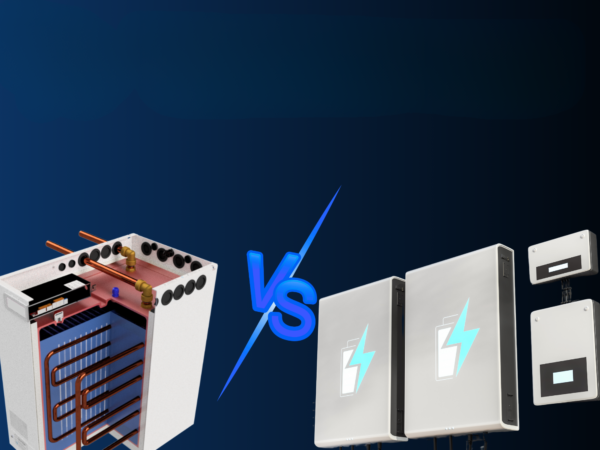
Thanks to the Plentigrade technology, Thermino is up to four times smaller than an equivalent hot water cylinder. Its sleek & modular design means it can be installed under kitchen worktops, utility cupboards, or under stairs space.
In the millions of UK homes that currently have a combi boiler and no cylinder cupboard, this is often the only realistic option for adding hot water storage without structural intervention.
No mandatory annual maintenance on the heat battery
The heat battery itself requires no routine maintenance once installed. Only the mandatory external components need periodic checking in line with the manufacturer’s instructions. Fewer annual callbacks means more time for new installations.
Inherently low legionella risk
Because Thermino stores heat in Plentigrade PCM rather than holding a large volume of hot water, there’s no stagnant water where legionella can thrive.
There’s no need for energy-intensive anti-legionella cycles.
What about limescale?
This is another practical point for installers & homeowners alike.
In traditional hot water cylinders, heating elements and hot water surfaces can be exposed to hard water. In hard water areas, limescale gradually builds up & acts as an insulator, so the system has to work harder to deliver the same heat into the water. Halcyan cites industry figures indicating that every 1 mm of limescale on a heating element can waste around 7% more energy, while other industry sources refer to a 7-10% impact on heat transfer efficiency.
Thermino works differently. Heat is transferred through a heat exchanger into Plentigrade phase change material, rather than relying on a heating element sitting in stored water. That helps protect long-term performance, especially in hard water areas where cylinder-related scale issues can contribute to slower heating, poor performance & higher energy consumption.
What makes Thermino smaller compared to an equivalent hot water cylinder?
Sensible heat vs latent heat
A traditional domestic hot water cylinder stores heat as sensible heat. That means the water stores useful energy as its temperature rises and releases that energy as it cools.
Its useful heat storage depends on two things: the volume of water, and the usable temperature delta, or ΔT. That ΔT is the useful temperature range of the stored water. It is the difference between the cylinder’s charged temperature and the lowest temperature at which it can still deliver reliable hot water.
The limitation is that water only stores useful energy across a relatively small temperature range, from “hot enough to use” down to “too cool to be useful.”
So, if the usable temperature delta is small, the water stores less useful heat per litre. To store the same amount of useful energy, the system needs more water volume, a larger cylinder and more space taken up in the home.
Thermino uses a different approach. It uses Sunamp’s Plentigrade phase change material to absorb & store incoming heat and change the state of the material. This is known as latent heat storage: much of the incoming heat is stored in the phase change itself, rather than simply increasing the material’s temperature. Crucially, that phase change of the material happens around the useful domestic hot water temperature range, so the battery stores a high amount of usable heat at the temperatures the system needs.
So instead of relying on a large volume of water cooling through a falling temperature range, Thermino stores heat in the highly energy dense PCM and releases it through the heat exchanger to deliver mains pressure hot water on demand.
The result is that Thermino can provide comparable hot water performance to a traditional cylinder in up to one quarter of the space.
Side by side comparison: unvented cylinder vs Thermino heat battery
Installer consideration |
Typical unvented cylinder |
Thermino heat battery |
Space |
Requires large amount of space. NDSS prescribes 0.5m2 of dedicated space for hot water storage. |
Up to four times smaller than an equivalent hot water cylinder. |
Stored medium |
Large volume of hot water |
Plentigrade phase change material stores latent heat. |
G3 route |
G3 certification required for installation, safety device and notification considerations |
Stores <15 litres of water in the heat exchanger, so G3 not required. |
Discharge pipework |
Safe discharge route and tundish required |
Not needed. |
Maintenance |
Safety components, PRV, anode where applicable |
No annual maintenance on the heat battery appliance, only on mandatory external components. |
Legionella management |
Stored water requires temperature management |
Designed to minimise Legionella risk by storing heat, not a large volume of water. |
Energy strategy |
Can be heated on schedule, but loses more heat over time |
Stores useful heat using PV or off-peak with very low standing losses, ready for hot water when required. |
Limescale |
Heating elements and wet surfaces can be affected in hard water area, adding to energy consumption |
Heat is transferred through the heat exchanger into PCM, reducing scale-related performance loss. |
Heat loss |
High, especially for older hot water cylinders |
2-4x lower due to vacuum insulation. |
Useful heat storage principle |
Sensible heat in water, limited by volume and usable ΔT |
Latent heat during phase change, giving higher useful energy density. |
The bigger points:
i) Thermino helps make heat pump systems work smarter
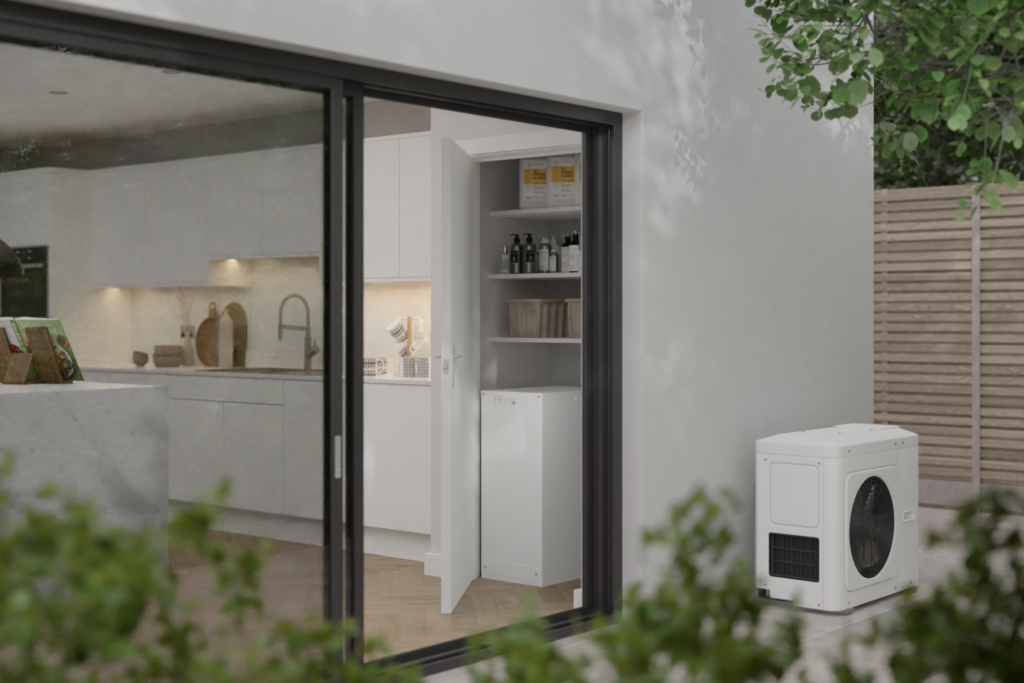
Thermino is not just smaller than a traditional cylinder, it also helps decouple when heat is generated from when hot water is used more efficiently than any other hot water appliance.
That matters because the best time to generate heat is often not the same as the time people need hot water.
A home may have surplus solar power in the middle of the day, cheaper electricity overnight, and peak hot water demand in the morning or evening. Thermino can store heat when it is cheaper or cleaner to generate, then hold it (more efficiently than any hot water cylinder) until hot water is needed.
For installers, that creates a stronger customer story: better use of solar PV, more flexibility with time-of-use tariffs, 2-4x standing losses, and a hot water system designed around how people actually live. It helps you offer customers a smarter heat pump-ready solution, not just another product.
ii) Optimino technology provides useful flexibility to customers
Installers are increasingly quoting for homes that will change over time. So, a customer might start with a cylinder replacement today, add solar PV next year and move to a heat pump later. Another might want to directly connect to grid and make use of off-peak tariff & add solar PV. The best hot water system should not force them to start again each time the heat source changes. Know more about the technology here.
iii) Thermino can futureproof your installation business
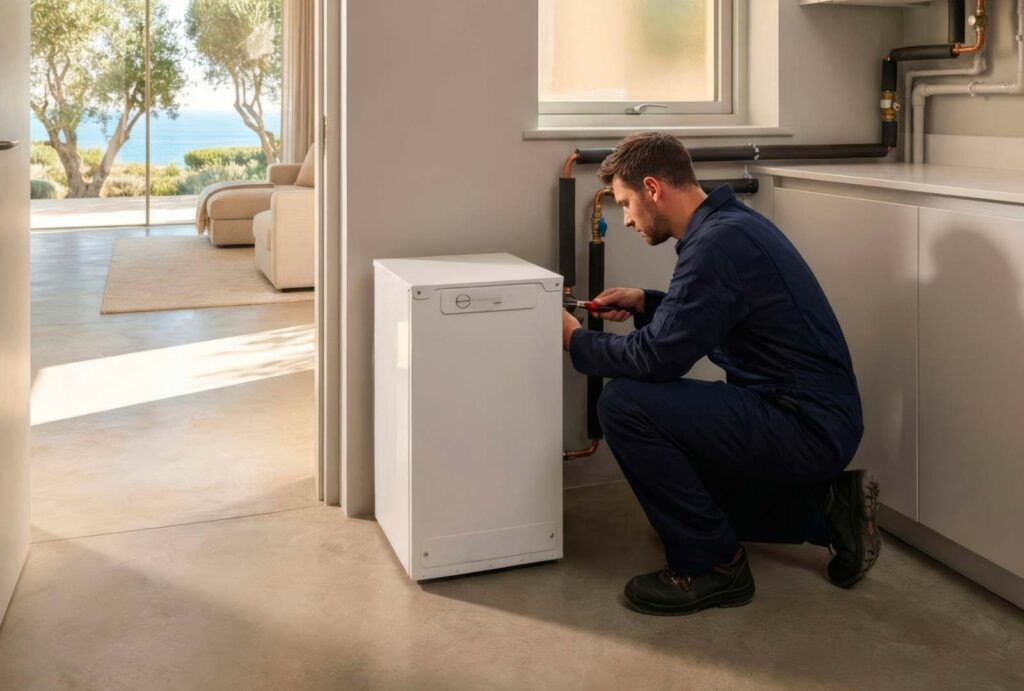
For the installer, the immediate benefit is straightforward. Thermino gives you another route to install heat pumps into difficult homes, i.e. the combi-boiler house with no cylinder cupboard, the flat where discharge pipework would be disruptive, or the renovation where the customer wants to install a heat pump but does not want to sacrifice storage space. Over 40,000 Sunamp Thermino units have been installed across the UK homes & beyond.
Heat Pump Association reports that a record 9,062 individuals completed a recognised heat pump qualification in 2024. The same HPA update also notes that the Government has extended its Heat Training Grant with funding to support a further 5,500 heat pump installers, on top of more than 10,650 people already trained through the scheme in its first two years.
For installers, that means one thing: futureproofing your business means being heat pump ready, and that means being ready with compact hot water storage that helps make more homes suitable for heat pumps.
Across Sunamp’s installer community, heating engineers are already sharing their experience of replacing traditional hot water cylinders with Thermino heat batteries in real homes. The feedback is consistent: Thermino helps solve the familiar retrofit challenges of space, cylinder removal, discharge pipework and customer disruption, while still delivering reliable mains-pressure hot water. You can view them here on our instagram channel.
Become a Sunamp-certified installer
Sunamp supports installers with free online Thermino training. Once completed, you can become a Sunamp certified installer and be listed on our installer map, helping homeowners and project teams find you more easily. It is a simple way to build product confidence, strengthen your low-carbon credentials and create more opportunities as demand for heat pump-ready homes grows.